.svg)
.svg)
.svg)
.svg)





.webp)
Noise is one of the leading sources of discomfort at work, often cited just after temperature or lighting. According to a 2015 Opinion Matters survey, 80% of employees in France say their work environment keeps them from concentrating. To address this, many companies look to acoustic materials.
But how do you know which material to choose for good office acoustics? In this article, we help you get a clearer picture of the key principles of sound in the office, and the role materials play in acoustic comfort.
What decibels really mean
The decibel (dB) scale isn't linear, it's logarithmic: every 10 dB increase is perceived by the ear as a sound twice as loud. For example, a normal conversation sits at around 60 dB, while a vacuum cleaner reaches 70 dB. A concert often exceeds 100 dB, a level that puts hearing under strain over long periods.
How does sound actually work?
Sound is a vibration that travels through the air, from particle to particle, forming a wave. When that wave hits a surface, it can react in four ways: it can be diffused, transmitted, reflected or absorbed. Diffusion scatters sound in several directions when it hits an uneven surface. Transmission lets sound pass through the wall. Reflection is when the wave bounces back. Absorption is when the surface takes the sound in. Depending on the surface it meets, sound is perceived differently by the human ear.
In a shared space with no absorbent materials, for example, every keystroke and every phone ring bounces off the walls and lingers in the room, creating constant background noise that's hard to tune out.
The materials that control sound
Two main families of materials are used in acoustics. They don't tackle the same problem at all, which is why you can't rely on one without the other
.webp)
Absorbent materials
On one side, absorbent materials: mineral wool, open-cell acoustic foam, felt, recycled textiles, cellulose wadding. What they have in common: a porous or fibrous structure. Sound enters, hits the fibres, and the sound energy dissipates as a tiny amount of heat through friction. Porous absorbers are most effective at mid and high frequencies. These materials calm echo and ambient noise inside a room, but do little to stop sound once it tries to get out.
Mass materials
Also known as barrier materials, they come in many forms: concrete, plaster, solid wood, thick glass, metal. Here, the logic is almost intuitive: the heavier a material, the more it tends to reflect sound rather than let it through. These materials effectively stop sound from getting in or out, but used alone, they send echo back into the room instead of calming it. Put simply: a thick wall without an absorbent turns a room into an echo chamber. An absorbent without a heavy wall behind it just lets sound pass. Both families of materials need to work together.
How do these principles apply to acoustic pods?
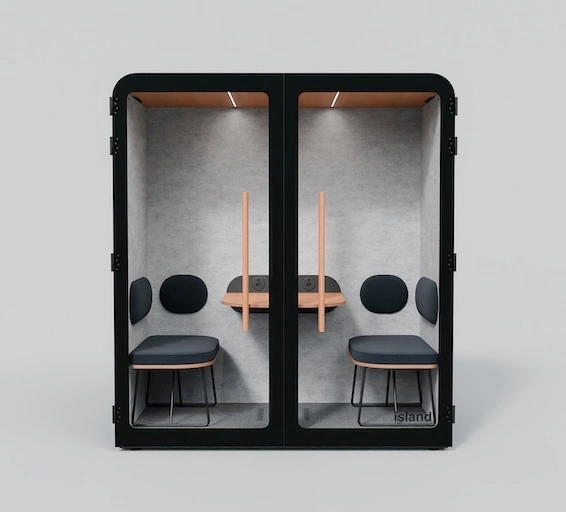
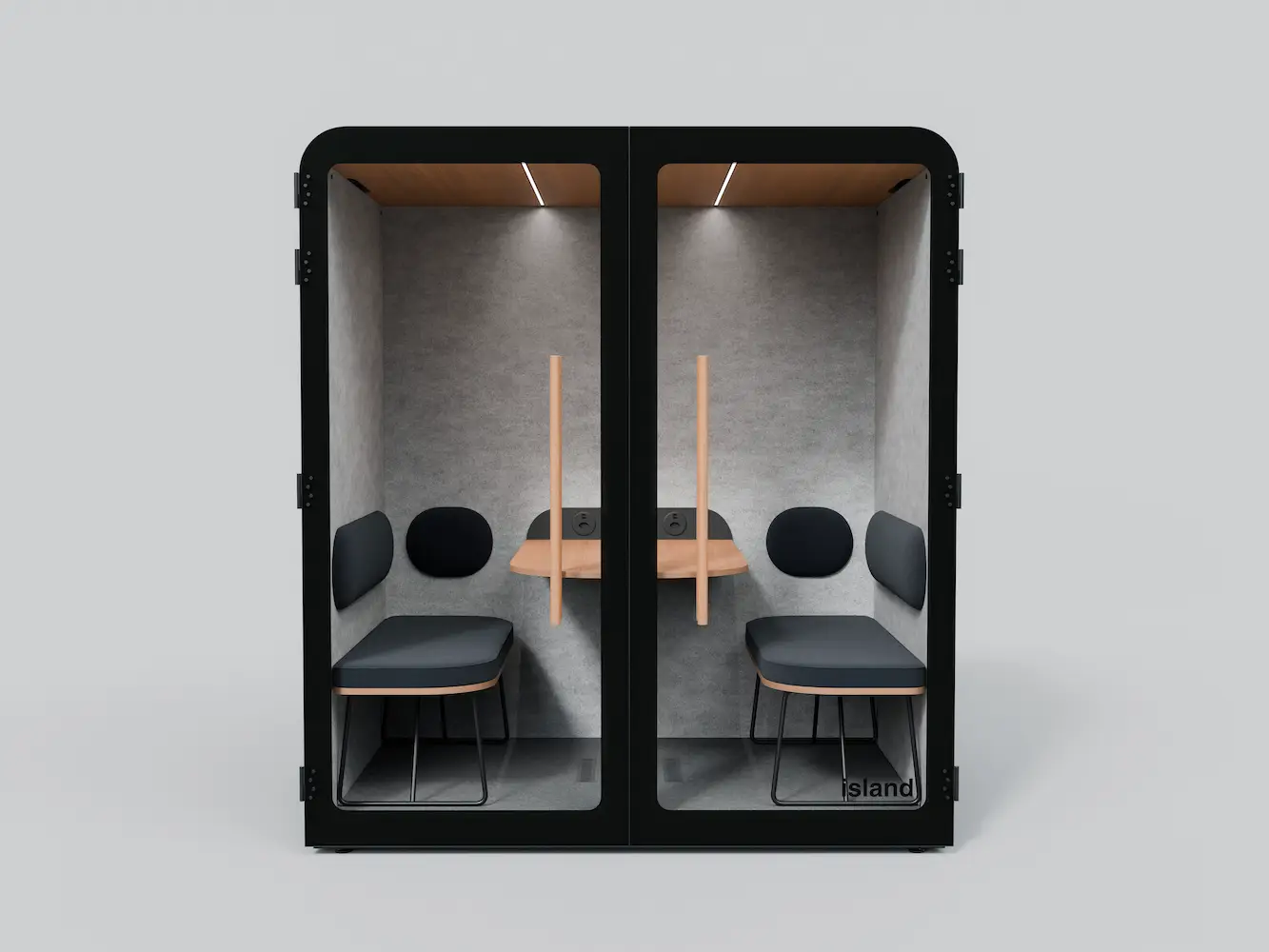
This combination of mass and absorbent materials is exactly what you'll find in our acoustic pods. The walls are built in three layers, each with its own function.
The first layer, a felt lining, captures the first sound waves and limits their reflection inside the pod, reducing echo as soon as sound comes in. Next comes the core of the absorption system: Métisse, a French textile insulation made from recycled cotton by our partner Le Relais. Made of at least 70% bio-based materials and around 85% recycled content, Métisse dissipates sound thanks to its absorbent properties.
.webp)
Sound enters, hits the fibres, and this friction turns sound energy into heat. The sound is dissipated. Finally, a rigid glass panel closes the system. This heavy barrier blocks and reflects whatever sound makes it through the insulation. The heavier the material, the more reliable the result. It's the combination of these three layers that creates the acoustic comfort and privacy of Work With Island pods.
The ISO 23351-1 standard
This combination of absorption and mass can be measured, and that's precisely what ISO 23351-1 does: it assesses how much sound escapes from a pod to the outside. The Island Desk, certified Class A, achieves a sound attenuation of 31.1 dB.
In short
Poor acoustics remain one of the leading sources of discomfort at work. Two families of materials address this issue. Absorbent materials calm ambient noise. Mass materials block its transmission from one room to another. Neither works alone. That's the balance built into the design of our acoustic pods. Felt limits echo. Métisse absorbs and dissipates sound. Glass blocks and reflects the rest. The result: a quiet space to focus, and a private one to talk freely.

.webp)

.webp)

.webp)
.webp)




.png)

.webp)
.webp)












.png)