To remember
19% of productivity lost and 15% more absenteeism
According to a 2017 Kantar TNS study, noise causes a 19% drop in productivity. Offices with no acoustic treatment record 15% more absenteeism and a 23% increase in turnover.
Regulation sets a maximum of 55 dB for shared offices
The decree of 30 August 1990 and the Labour Code (Articles R4213-7 to R4213-11) govern noise levels in companies. Beyond that, the employer's criminal liability is engaged. An assessment (sound level meter or the GABO questionnaire) can help measure the situation.
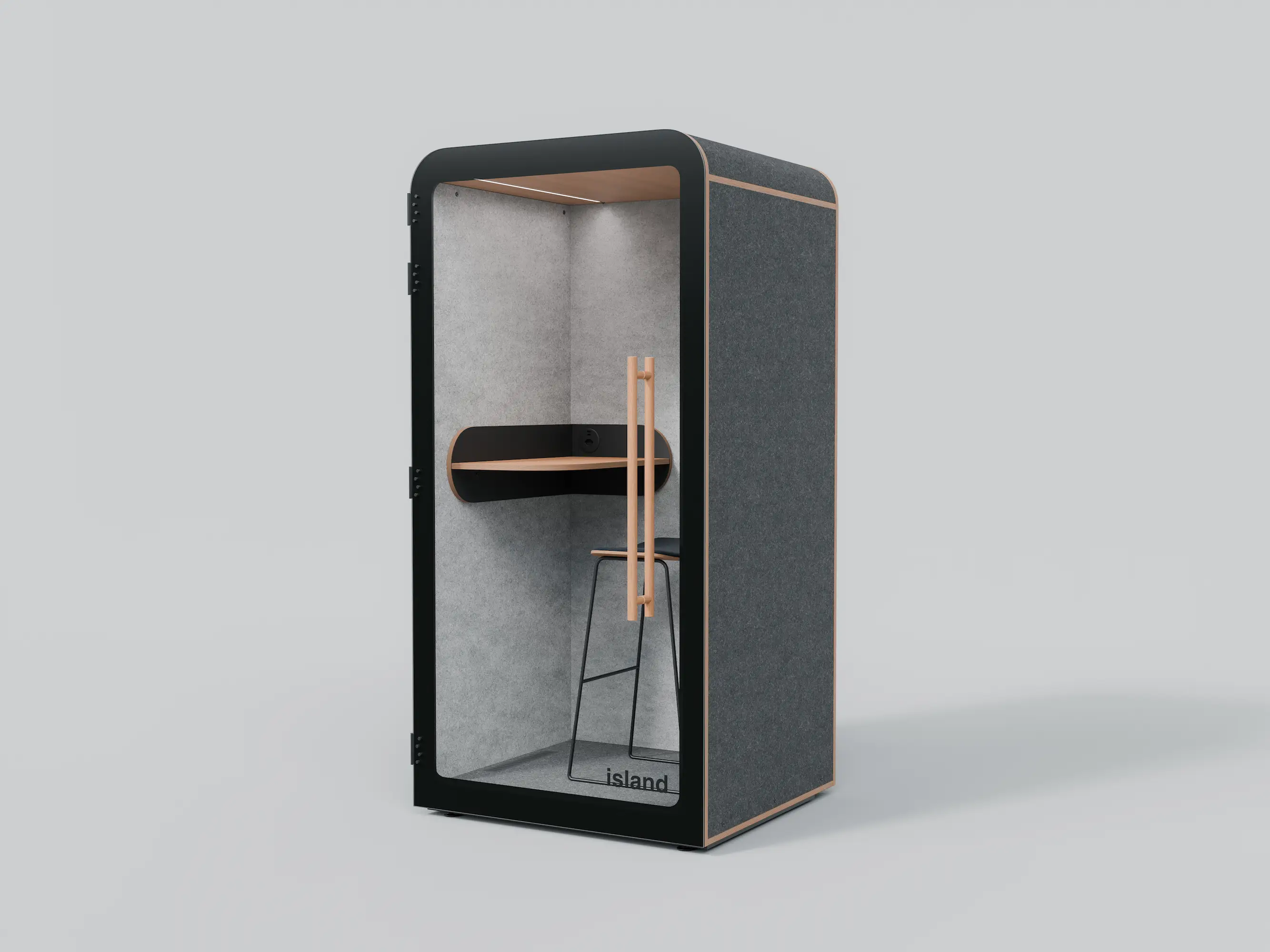
Acoustic pods: certified insulation, installed in under an hour
Island Solo: 30.2 dB (Class A). Island Desk: 31.1 dB (Class A). Island Duo: 28.7 dB (Class B). Island Quattro: 29.8 dB (Class B). No construction work, no permits. Leasing from €68/month.
Made in France, 5-year warranty
Origine France Garantie label, PEFC wood, Métisse® insulation, B Corp 2025. More than 4,000 companies supported, 15,000 installations completed. 100-day money-back trial.
Why is there noise in our offices?
Workplace noise stems from three main factors that turn our professional spaces into genuine sources of acoustic stress.
Conversations and communication are the top cause of noise disturbance in companies. In an open-plan office with 50 people, conversations account for 70% of measured noise disturbance, according to a 2023 INRS study on workplace acoustics. Informal chats, phone calls and impromptu meetings create a constant ambient noise that disrupts focus. Every spoken exchange generates noise peaks between 55 and 75 dB, far exceeding comfort thresholds.
The technical and structural environment amplifies this disturbance. Ventilation systems generate a constant background noise between 45-55 dB, in line with the AFNOR NF S31-080 standards. IT equipment, printers and air conditioning add their own sound frequencies. This technical infrastructure creates a permanent sound base on top of which every other office noise is layered.
Unsuitable office design multiplies the impact of every sound source. The absence of partitions in open-plan offices, reflective materials like glass and concrete, and occupancy density turn every sound into an echo. Glazed surfaces triple sound reverberation, creating a resonance-box effect.
The main noise sources identified include:
- Conversations and calls: 60-75 dB
- IT equipment: 40-50 dB
- Ventilation and air conditioning: 45-55 dB
- Foot traffic and movement: 50-60 dB
- Ringtones and notifications: 65-80 dB
- Office equipment: 45-65 dB
- Outside noise: 40-70 dB
- Meetings and presentations: 70-85 dB
The consequences of noise for employees
Workplace noise disturbance generates measurable impacts across three essential dimensions of employee performance and wellbeing.
Impact on productivity and focus
Noise significantly degrades employees' cognitive abilities. According to a study from the University of California, Irvine, it takes 23 minutes to regain focus after a noise interruption. This fragmented attention reduces productivity by 66% and increases the error rate by 27%. Tasks requiring deep thought become particularly difficult in a noisy environment, forcing employees to work twice as hard to maintain their level of performance.
Effects on health and wellbeing
Prolonged noise exposure causes measurable physiological reactions. WHO research on workplace noise shows a 40% increase in cortisol levels in noisy environments. This stress hormone leads to chronic fatigue, irritability and sleep problems. Employees exposed daily to more than 55 dB develop symptoms of burnout more quickly and experience lasting attention problems.
Organisational consequences
The impact of noise directly affects companies' HR indicators. Offices with no acoustic treatment record 15% more absenteeism and a 23% increase in turnover. Quality of work life deteriorates, creating a vicious cycle in which the highest performers leave for calmer environments.
Want to know more about our soundproof booths?
Get our product guide by email. A clear, complete document with dimensions, weight and available options for our soundproof booths.
Download the product guide
Office acoustic standards and regulation
French regulation strictly governs acceptable noise levels in the workplace to protect employee health.
French regulatory thresholds set precise limits under the Labour Code. The decree of 30 August 1990 sets a maximum of 55 dB for shared offices and 50 dB for focus spaces. These decibel limits are a legal obligation for employers, who must guarantee working conditions that protect auditory health. Articles R4213-7 to R4213-11 of the Labour Code set out the mandatory prevention measures and the penalties for non-compliance.
AFNOR standards and certifications complement this regulatory framework. The NF S31-080 standard defines acoustic measurement methods and performance criteria for noise solutions. More recently, the ISO 23351-1 standard ranks the acoustic performance of workspaces from A to D, offering an international framework for assessing office sound quality. This certification lets companies demonstrate compliance with acoustic best practices.
How do you measure noise at work?
Precisely assessing noise disturbance requires professional tools and a rigorous methodology to get reliable results.
The GABO questionnaire, validated by the INRS, complements the technical approach with a subjective assessment of noise disturbance. This proven method measures how employees perceive noise, across 12 standardised criteria. A GABO score above 50 indicates significant disturbance requiring immediate corrective action. The tool correlates objective measurements with how teams actually feel.
The 5 steps of a complete acoustic assessment:
- 48-hour sound mapping of the spaces
- Identifying the main noise sources
- GABO questionnaire with employees
- Analysing noise peaks by time period
- Tailored recommendations by zone
Work With Island supports your project
Work With Island offers a full range of certified acoustic pods to permanently solve office noise problems. Our Island Solo, Desk, Duo and Quattro offer noise reduction of -28 to -31 dB under the ISO 23351-1 standard.
Guaranteed acoustic certification: The performance of our acoustic pods is certified ISO 23351-1 Class A or B (depending on the model) through independent laboratory testing. This measured, guaranteed noise reduction gives you scientifically proven effectiveness. Every pod undergoes strict quality checks to maintain these standards of acoustic excellence.
Responsible French manufacturing: 100% made in France, in the Vendée region, with B Corp certification and Origine France Garantie. 96% of components are sourced locally, reducing our carbon footprint and supporting the French economy. This eco-responsible approach aligns perfectly with modern companies' CSR values.
Turnkey installation and service: Installation in under 1 hour with no construction work, with more than 15,000 pods installed and fast delivery across Europe. Our Paris-based team guarantees responsive customer service and technical expertise recognised by more than 4,000 client companies.
"What our employees told us: noise is wearing and tiring. They need moments to recharge, to settle down and step away. The pod lets you step away completely, into a zero-decibel atmosphere." - Jérôme Bourdon, co-founder of WiiSmile.
Is your open-plan office struggling with noise disturbance? Contact Work With Island for a free assessment and discover our certified acoustic pods. Request your personalised quote.
“Merci beaucoup à Work With Island qui fabrique les meilleures phone booth rapport qualité-prix ! L’esthétique est tout aussi réussie, l’accord bois/feutre s’accorde parfaitement dans tous les espaces de bureaux que j’ai pu aménager.”
Jérôme Bourdon
Co-founder of WiiSmile
Frequently asked questions
What are acceptable noise levels in an office?
French regulation sets a maximum of 55 dB for shared offices. Ergonomic recommendations suggest 45-50 dB for focus work and 50-55 dB for collaborative activities. These thresholds guarantee comfort and productivity.
How do you measure noise at work?
Use a certified Class 2 sound level meter to measure levels in dB(A). Take readings over several days during peak hours. Complement this with the GABO questionnaire to assess the disturbance felt. A professional assessment is still recommended.
What are the main sources of noise in an open-plan office?
Conversations account for 70% of disturbance, followed by phone calls (15%), IT equipment (10%) and ventilation (5%). Unsuitable office design amplifies these sources through reverberation off hard surfaces.
How much does an office noise solution cost?
Solutions range from €68/month on leasing for an individual pod to several thousand euros for a complete acoustic treatment. Work With Island offers certified pods from €3,990 excl. VAT, with installation included.
Can I reduce noise without major construction work?
Yes, several no-construction-work solutions exist: modular acoustic pods, mobile panels, sound-insulating furniture and a code of conduct. Work With Island pods are installed in 1 hour with no changes to the building.
Are acoustic solutions really effective?
Certified solutions guarantee measurable performance. Our pods offer -28.7 to -31.1 dB of reduction under the ISO 23351-1 standard. More than 4,000 companies trust us, with a measured client satisfaction rate of 96%.
.svg)
.svg)
.svg)
.svg)







.png)