To remember
19% of productivity lost to office noise
According to a 2017 Kantar TNS study, noise causes a 19% drop in productivity and a measurable increase in stress. Beyond 55 dB, the impact on health and focus becomes immediate.
Regulation sets precise thresholds by space
The AFNOR NF X35-102 standard recommends 40 dB for individual offices, 50 dB for open-plan offices and 55 dB for circulation zones. Beyond that, the employer's liability is engaged.
Acoustic pods: the most effective solution, with no construction work
Certified reduction of up to -31.1 dB under the ISO 23351-1 standard. Installed in under an hour, with no changes to the building. Leasing from €68/month. 100-day money-back trial.
A comprehensive approach cuts noise by a further 40%
Combining acoustic zoning, absorbent furniture and a behavioural charter delivers results far superior to technical solutions alone. A 30% improvement in employee satisfaction after acoustic treatment.
The impact of noise on workplace performance
Noise pollution at the office is a major issue that's often underestimated. Studies reveal direct consequences for employee performance and wellbeing, fully justifying investment in acoustic treatment.
The costs of noise pollution are considerable. According to a 2017 Kantar TNS study, noise causes a 19% drop in productivity. This decline comes with increased stress, difficulty concentrating and a general decline in wellbeing. The INRS, the French national research and safety institute, ranks noise among the main psychosocial risks at work.
In the projects we support, we see a 30% improvement in employee satisfaction after acoustic treatment. This improvement translates into better talent retention and reduced absenteeism.
Regulation defines precise recommended noise levels under the AFNOR NF X35-102 standard. Thresholds range from 35 to 55 dB depending on the activity: individual office 40 dB maximum, open-plan office 50 dB, circulation zone 55 dB. Beyond these levels, the impact on health and productivity becomes measurable.
Want to know more about our soundproof booths?
Get our product guide by email. A clear, complete document with dimensions, weight and available options for our soundproof booths.
Download the product guide
Structural sound-insulation solutions
Structural sound insulation is the foundation of effective noise treatment. These permanent solutions act directly on the building envelope to absorb and reduce sound transmission.
Treating ceilings and walls
Acoustic panels are the most common solution for treating vertical and horizontal surfaces. These absorbent materials come in wall-mounted and suspended versions, offering different absorption coefficients depending on their composition.
Rock-wool wall panels offer an absorption coefficient of 0.85 to 0.95 depending on frequency, ISO certified. This technical performance significantly reduces reverberation in the space. Suspended acoustic panels effectively complement the treatment by targeting downward sound waves.
Installation requires a preliminary study to optimise positioning. Plan for €50 to €150/m² depending on quality and desired performance. Design solutions now combine aesthetics and performance, turning acoustic treatment into a decorative element.
Floor insulation
Floor insulation specifically treats impact noise generated by movement and handling objects. Switching from tiling to acoustic carpet reduces impact noise by 15 to 20 dB, an improvement that's particularly noticeable on upper floors.
Modular acoustic tiles offer a flexible alternative to traditional flooring. These solutions allow for partial replacement and make it easier to access technical networks. Recycled materials like cork or recycled textile fibres combine acoustic performance with an environmental approach.
Acoustic furniture and equipment
Acoustic furniture brings flexibility and modularity to sound treatment. These mobile solutions adapt as the organisation evolves and allow for fine-tuning acoustics as needed.
Movable partitions and dividers
Movable acoustic partitions create temporary or permanent quiet zones. A 160 cm acoustic screen reduces sound transmission by 8 to 12 dB depending on its composition, enough to create a focus bubble.
Wheeled dividers make it easy to reconfigure workspaces. These modular solutions adapt to meetings, focus sessions or phone calls. Design screens combine storage and acoustic treatment, optimising space use.
Individual noise screens attach directly to workstations. This targeted approach treats local disturbance without changing the overall architecture of the space.
Acoustic pods
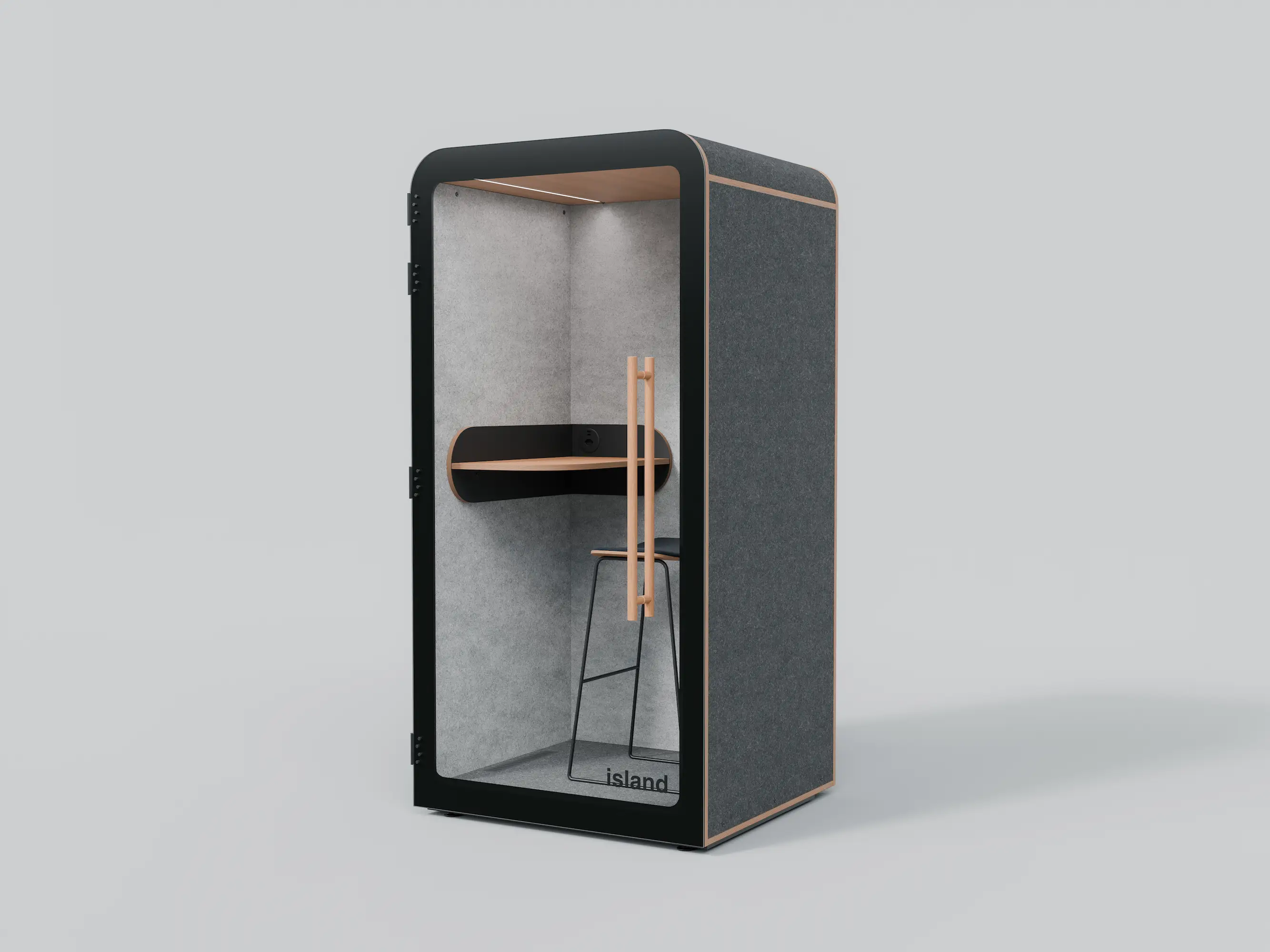
Acoustic pods are the most effective "box within a box" solution. These isolated spaces create zones of total silence for calls and intense focus, with no need for major construction work.
Our Island pods offer noise reduction of up to -31.1 dB under the ISO 23351-1 standard, Category A or B depending on the model. This certified performance guarantees optimal insulation for any activity requiring calm. Plug-and-play installation allows for a fast rollout with no disruption to the business.
Installation flexibility is a major advantage over fixed partitions. These solutions are easy to move during reorganisations and retain their value if you relocate.
Smart space design
Acoustic layout optimises spatial organisation to naturally limit noise disturbance. This space-planning approach maximises the effectiveness of other technical solutions.
Acoustic zoning separates noisy activities from quiet zones. Positioning call spaces away from focus zones reduces disturbance by 40%. This rational organisation limits usage conflicts and improves overall comfort.
Optimised circulation avoids stray traffic through focus work zones. Transition spaces absorb disturbance before it reaches workstations. This architectural approach effectively complements technical solutions.
Strategic positioning keeps noise sources away from sensitive zones. Positioning printers and coffee machines on the periphery limits their sound impact on the whole space. Natural obstacles like columns or existing partitions create free acoustic barriers.
Our experience from more than 15,000+ installations confirms the importance of this comprehensive approach. Projects that combine smart layout with technical solutions achieve the best user satisfaction results.
Fit-out best practices:
- Group noisy activities together
- Create buffer zones
- Use natural obstacles
- Position workstations with their back to noise sources
Behavioural and organisational solutions
The human approach necessarily complements technical solutions. These best practices need support and training to ensure they're durably adopted.
A sound-etiquette charter sets clear, shared usage rules. This team awareness covers using dedicated call spaces and respecting quiet zones. Setting "silent" slots from 9am to 11am improves focus by 25%, according to our observations.
Dedicated call spaces prevent disturbance from spreading across the whole open-plan office. This arrangement needs management support to ensure established rules are respected.
Training and communication raise awareness of noise's impact on collective performance. Using alternative communication tools reduces vocal interruptions. Visual indicators, like status lights, signal quiet zones with no additional disturbance.
As Jérôme Bourdon, co-founder of WiiSmile, puts it: "What our employees told us: noise is wearing and tiring. They need moments to recharge, to settle down and step away." This collective awareness makes it easier to adopt new practices.
Advanced technical solutions
Innovative technology complements the arsenal of traditional acoustic solutions. These technical approaches offer interesting alternatives depending on space and budget constraints.
Sound masking uses controlled sound playback to mask stray noise. White or pink noise at 45 dB effectively masks conversations without disturbing focus activities. This technique needs precise tuning to avoid creating additional noise pollution.
Smart playback systems automatically adapt to ambient noise levels. These technical solutions maintain an optimal masking level with no manual intervention. Optimal frequencies vary with activity and require a preliminary acoustic study.
Individual equipment offers personalised protection against disturbance. Active noise-cancelling headphones eliminate up to 30 dB of ambient noise, an effective solution for activities requiring intense focus. This individual approach complements collective treatment.
Active technology analyses the sound environment in real time and adapts its response. These sophisticated solutions suit complex environments with variable disturbance.
Work With Island supports your acoustic project
Work With Island designs and manufactures 100% French acoustic pods to create quiet spaces right in the middle of your offices. Our Island Solo, Desk, Duo and Quattro offer certified noise reduction of up to -31.1 dB under the ISO 23351-1 standard.
Our 100% French manufacturing in the Vendée region, and our B Corp certification, guarantee a controlled environmental impact. This responsible approach meets companies' growing CSR expectations.
More than 15,000+ installations completed since 2018 reflect our expertise. This experience lets us effectively support any type of project.
Turnkey installation in under an hour, anywhere in Europe, makes rollout easy. Our leasing service from €68/month makes these solutions accessible for any budget. This financial flexibility lets you test effectiveness before a wider rollout.
Need quiet spaces to improve your teams' focus? Contact Work With Island for a free acoustic assessment and discover our certified pods.
“Merci beaucoup à Work With Island qui fabrique les meilleures phone booth rapport qualité-prix ! L’esthétique est tout aussi réussie, l’accord bois/feutre s’accorde parfaitement dans tous les espaces de bureaux que j’ai pu aménager.”
Jérôme Bourdon
Co-founder of WiiSmile
Frequently asked questions
How do you reduce office noise?
Combine technical solutions (acoustic panels, partitions), smart layout (zoning) and behavioural rules. The most effective approach combines structural insulation with dedicated spaces like acoustic pods. A reduction of 15 to 25 dB significantly improves comfort.
What are the recommended noise levels for an office?
The AFNOR NF X35-102 standard recommends a maximum of 40 dB for individual offices, 50 dB for open-plan offices and 55 dB for circulation zones. Beyond 55 dB, productivity drops by 19%, according to a 2017 Kantar TNS study.
What materials should you use for sound insulation?
Choose porous materials: rock wool (coefficient 0.85-0.95), acoustic foam, recycled-fibre panels. For flooring, go for carpet or acoustic tiles. Hard materials reflect sound, soft materials absorb it.
How much do acoustic panels cost?
Plan for €30 to €150/m² depending on the material and performance. Decorative wall panels cost €50-80/m², suspended acoustic panels €40-120/m². Installation represents 20-30% of the total cost. The return on investment shows up as improved productivity.
How long does an acoustic solution take to install?
Mobile solutions (screens, pods) are installed in 1 to 3 days. Structural work (ceilings, partitions) needs 1 to 2 weeks depending on the area. Our Work With Island pods are assembled in under 1 hour, with no construction work.
Can I improve acoustics without major construction work?
Absolutely. Start with mobile solutions: acoustic screens, repositioning furniture, acoustic pods. Add rugs, curtains and absorbent objects. These solutions deliver 60% of the benefits for 30% of the cost of major construction work.
.svg)
.svg)
.svg)
.svg)






.png)