Choose shipping location in order to see the correct pricing, delivery times and shipping costs. Prices of items may vary based on your shipping destination to reflect local market pricing and taxes.
Meeting Rooms: Choosing the Right Workspace for Your Team
Between noisy open plan offices, traditional meeting rooms that sometimes sit underused, and new needs tied to hybrid working, sizing your meeting spaces has become a real, practical issue for companies.
This guide walks through the selection criteria, the types of spaces available, and complementary solutions like acoustic pods.
Since 2018, Work With Island has supported more than 4,000 companies across Europe in fitting out their collaborative spaces.
The type of meeting, its length and the number of participants determine the right format. Start with the use, not the square metres.
Mix your formats
Acoustic pods for short, confidential formats, traditional rooms for large formal meetings, informal spaces for creativity.
Aim for at least 25 dB of insulation
To guarantee privacy and avoid disruption, aim for at least 25 dB of sound reduction (Class B to A to the ISO 23351-1 standard).
Try before you commit
Acoustic pods install in around 30 minutes and come with a 100-day trial before you commit.
Types of meeting rooms and their uses
The right type of space depends on your needs and your organisation. Companies today are diversifying their spaces to support different forms of collaboration.
Traditional meeting rooms
Classic conference rooms remain the reference for formal meetings. They typically fit 6 to 20 people and come with standard equipment: a central table, ergonomic chairs and a presentation screen. These spaces suit management committees, client presentations and training sessions.
A 15 m² room can comfortably fit a team of 8 with a 65-inch screen. A U-shaped layout supports active conversation, while a theatre layout maximises capacity for presentations.
Informal meeting spots are changing traditional collaboration. Modular furniture, comfortable sofas and mobile coffee tables create a relaxed atmosphere that sparks creativity. These spaces support spontaneous brainstorming and exchanges between teams.
Informal meeting spaces
Lounge corners let you reconfigure the space quickly based on need. This flexibility meets the expectations of newer generations, who favour less rigid environments.
Acoustic pods and phone booths
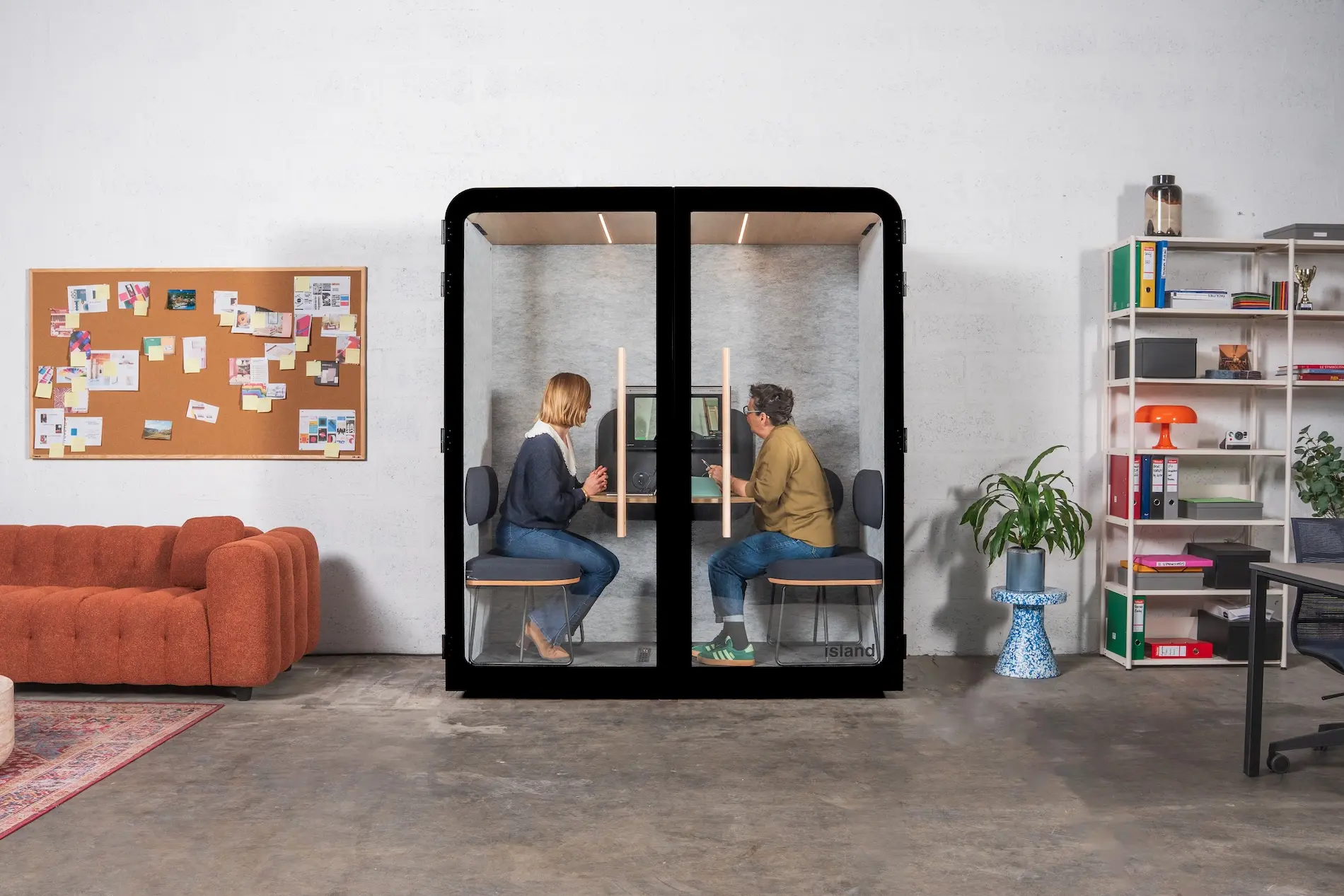
Acoustic pods offer a new approach to meeting spaces in business. These compact solutions fit 1 to 4 people and provide strong sound insulation with no building work needed. Their fast installation and mobility make them a good fit for agile organisations.
A two-person pod like the Island Duo, with a sound reduction of 28.7 dB (Class A to the ISO 23351-1 standard), guarantees private conversations even in an open plan office. This acoustic performance means you can take client calls or hold HR interviews without disturbing the rest of the workspace.
Comparing the three formats:
Space type
Traditional room
Informal space
Acoustic pod
Capacity
6-20 people
4-8 people
1-4 people
Main use
Formal meetings
Brainstorming
Confidentiality
Advantages
Full equipment
Flexibility
Fast installation
Selection criteria for your meeting rooms
Choosing the right meeting spaces means weighing up several criteria. These factors decide how effective meetings are and how comfortable employees feel day to day.
Capacity and layout
Working out a meeting room's capacity follows a simple rule: plan for around 2.5 m² per person to guarantee comfort (a common industry rule of thumb, including circulation and technical equipment).
Layouts vary depending on the meeting's purpose. A U-shaped layout supports active participation with a maximum of 8 to 12 participants. A theatre layout maximises capacity for presentations, while pods of tables suit small-group work.
A modular room can go from 8 to 16 people depending on the layout chosen. That flexibility makes the best use of the space and adapts to different meeting formats.
Acoustics and privacy
Sound insulation is a decisive factor for the quality of a conversation. A sound reduction of at least 25 dB is recommended to guarantee privacy and avoid outside disruption. The ISO 23351-1 standard sets out how to measure speech reduction for workspaces and acoustic enclosures.
Absorbent materials built into partitions and ceilings improve internal acoustics. This reduces listening fatigue and improves understanding during conversations, especially on video calls.
“The pods have improved our workspace by freeing up our larger meeting rooms while still allowing people to jump on spontaneous calls whenever they need.”
Estela Sánchez
Head of People Wellbeing and Onboarding Specialist at Seedtag
Technology equipment
Modern connectivity needs a complete setup: strong WiFi, multiple power sockets and built-in USB ports. This basic equipment covers the personal and professional devices used every day.
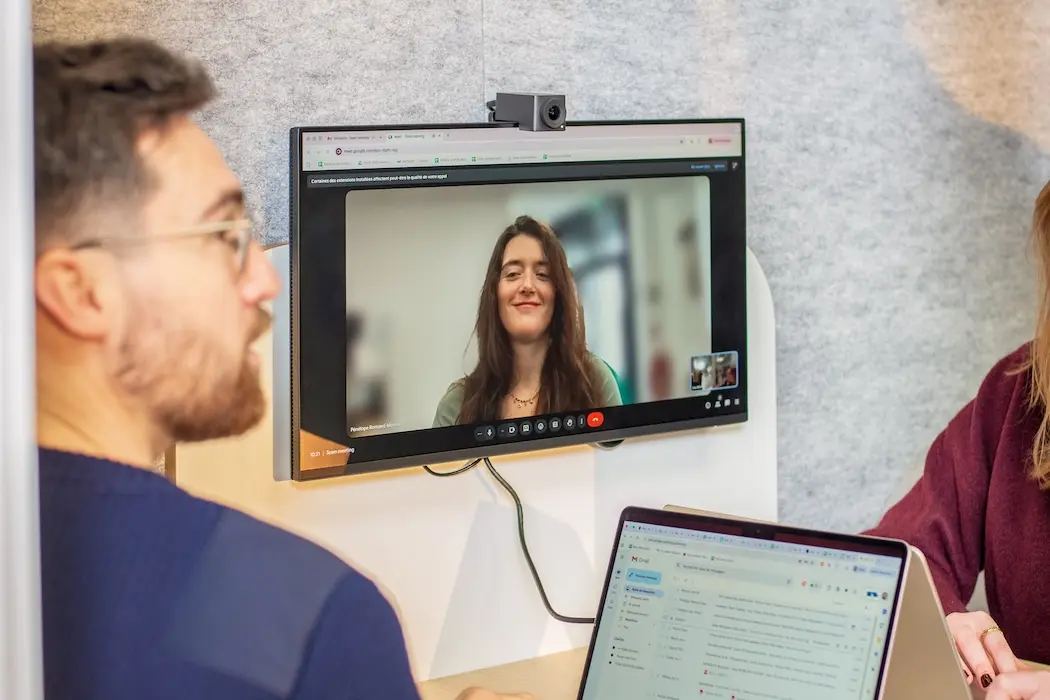
Audiovisual equipment (high-definition screens, audio systems, video conferencing solutions) makes hybrid meetings easier, mixing people in the room with people joining remotely. It's now a standard part of how work gets organised.
Internal meeting
Screen, WiFi, power sockets
Client presentation
Projector, audio system, adjustable lighting
Video conferencing
HD camera, omnidirectional microphones, speakers
Training
Interactive whiteboard, recording system
Fit-out solutions for your constraints
Every company faces constraints that shape the choice of meeting spaces. Adapting the solution to the context guarantees a relevant, lasting investment.
Tight spaces
Optimising space becomes strategic in city offices where every square metre counts. Compact, modular solutions make the most of available floor space without compromising functionality.
One and two-person acoustic pods offer a compact alternative to traditional rooms. A one-person pod like the Island Solo or the Island Desk takes up around 1 m² of floor space while guaranteeing the insulation needed for private calls and individual focus.
Noisy open plan offices
Open environments need stronger sound insulation to create pockets of calm. Solutions with no building work fit into the existing layout without disrupting daily activity.
Customer feedback confirms that noise is tiring and wears people down, and that pods let people isolate themselves completely. This issue particularly affects sales and customer support teams, who take many calls every day.
Which format for which type of meeting?
Meeting type
Client call or focused work
HR interview, 1:1 video call
Small team meeting
Formal presentation
Creative brainstorming
Typical length
15 to 30 min
30 to 60 min
45 to 60 min
1 to 2 h
1 to 3 h
Recommended format
Solo or Desk pod
Duo pod
Quattro pod
Traditional room
Modular informal space
5 criteria for sizing your meeting rooms
Capacity and layout Plan for 2.5 m² per person for a traditional room, 1 to 4 people for a pod. Choose the layout based on the goal (U-shape, theatre, pods of tables).
Acoustics and privacy At least 25 dB of sound reduction. ISO 23351-1 for pods, NF S31-080 for offices.
Technology equipment WiFi, sockets, USB, screen, HD camera and omnidirectional microphones for video calls.
Flexibility and modularity Reconfigurable furniture, movable pods, digital booking to optimise occupancy.
Overall budget Add up the traditional room, complementary pods and technology equipment from the initial budget onward.
Want help fitting out your office?
For 8 years, Work With Island has supported more than 4,000 companies, let's talk!
Fitting out meeting rooms needs to follow a regulatory framework. These requirements guarantee safety and accessibility in workspaces.
Fire safety
Materials used in premises open to the public must meet an M1 or M0 classification to limit fire spread. This applies to wall coverings, flooring and furniture installed in meeting spaces (French decree of 25 June 1980, as amended).
Emergency exits must stay clear at all times, with functioning emergency lighting in the event of a power cut.
Air quality
Ventilation must renew the air at a minimum of 25 m³/h per person (French Labour Code, article R4222-6 for premises with no specific pollution source). This maintains sufficient air quality and avoids the CO2 build-up that gets in the way of focus.
Automatic ventilation systems, like those fitted in modern pods, guarantee regular air renewal. Combined with VOC-free materials, this ventilation creates a healthy environment.
Main applicable standards:
• Fire safety: French decree of 25 June 1980, as amended (premises open to the public)
• Ventilation: French Labour Code, article R4222-6
• Office acoustics: NF S31-080
• Speech reduction (pods): ISO 23351-1
Good to know:
Acoustic pods don't replace traditional rooms, they take the pressure off them. Companies that add Work With Island pods see their larger rooms freed up for formal meetings, and fewer booking conflicts for 1 to 4 person formats. The pod investment adds to what's already there rather than replacing it.
Trends and innovations in meeting spaces
The evolution of meeting spaces reflects broader changes in the world of work. These innovations respond to employee expectations and today's organisational constraints.
Hybrid working and flexibility
Hybrid working is redefining how meeting spaces get used. Modular solutions allow quick reconfiguration to fit daily needs, while real-time booking systems optimise room occupancy.
Bringing remote and in-office work together calls for strong video conferencing equipment in every space. This technology helps remote colleagues take part and keeps teams connected.
Wellbeing and biophilia
Well-optimised natural light improves visual comfort and reduces fatigue during longer meetings. Adding plants and natural materials creates a calming atmosphere that supports creativity and constructive conversation.
Ergonomic furniture and equipment prevent postural tension. Adaptive lighting keeps visual conditions comfortable throughout the day.
Sustainable development
Local manufacturing and the use of recycled materials address environmental concerns. Certifications like B Corp or Origine France Garantie offer verifiable guarantees of a responsible approach.
Work With Island acoustic pods carry the Origine France Garantie label, and the company earned B Corp certification in 2025.
Work With Island offers a new-generation range of acoustic pods: Island Solo and Island Desk for individual focus, Island Duo for two-person conversations, Island Quattro for meetings of up to 4 people. These solutions complement traditional meeting rooms for uses that need privacy, flexibility and quick deployment.
Here are a few key features:
• Sound reduction: Island Solo -30.2 dB, Island Desk -31.1 dB, Island Duo -28.7 dB, Island Quattro -29.8 dB
• Installed in around 30 minutes, no building work
• Automatic ventilation (air renewed every 15 to 20 seconds depending on the model)
• Full connectivity (220V sockets, USB-A and USB-C ports)
Our 2025 B Corp certification and the Origine France Garantie label reflect a genuine commitment to responsible practice. This double certification guarantees ethical, local manufacturing that meets CSR requirements.
More than 4,000 clients have trusted our expertise since 2018. Companies like LVMH, L'Oréal and SNCF use our pods to make better use of their space and cut down on room-booking conflicts.
Looking for an acoustically effective meeting solution? Contact Work With Island to discover our pods and enjoy a 100-day trial.
Looking for an acoustic solution for your office meetings?
Fill in the form and get our product guide right away. A clear PDF with everything you need: price, dimensions, connectivity and more.
FR
FAQ on meeting rooms
What equipment is useful in a meeting room?
Assess your needs: number of users, how often and what kind of meetings. Consider acoustics (at least 25 dB of reduction recommended), technology equipment and accessibility. Acoustic pods offer a compact solution for 1 to 4 person formats. For traditional rooms, plan for around 2.5 m² per person.
What technology equipment does a meeting room need?
The basics: a screen or projector, stable WiFi, power sockets, adjustable lighting, compliant ventilation. For video calls: an HD camera, omnidirectional microphones, speakers. Modern pods come with this equipment built in as standard.
What's the average price to rent a meeting room?
Rental rates range from €25/hour for a basic room to more than €150/hour for a premium city-centre space. To buy, an acoustic pod ranges from €3,990 excl. VAT (Island Solo) to €9,990 excl. VAT (Island Quattro). The Work With Me Again programme also offers refurbished pods at a reduced price.
How long does it take to install an acoustic pod?
Full installation in around 30 minutes, with no building work. Work With Island pods are delivered pre-assembled as a kit, with instructions. No changes to the building: just a standard power connection. Designed to be dismantled for moving or reconfiguring.
Can I try a pod before buying?
Yes. Work With Island offers a 100-day trial with a full refund if you're not satisfied, on every pod. This period lets you see how your teams adopt it and its effect on productivity in real conditions.
Does an acoustic pod replace a meeting room?
For 2 to 4 person meetings: yes, entirely. The sound insulation (Duo 28.7 dB, Quattro 29.8 dB, Class A to ISO 23351-1) guarantees privacy, and the built-in equipment ensures comfort. Many companies, like LVMH, L'Oréal and SNCF, use pods alongside their traditional rooms to make better use of their space and cut down on booking conflicts.
Our customers choose our pods for their performance, design and durability.
15,000+
acoustic pods delivered across Europe
4,000+
customers who have added our products to their offices
12
pods returned after the 100-day trial since we started
.svg)
.svg)
.svg)
.svg)