Choose shipping location in order to see the correct pricing, delivery times and shipping costs. Prices of items may vary based on your shipping destination to reflect local market pricing and taxes.
73% of employees in open-plan offices report being regularly disturbed by noise, according to an INRS study on workplace acoustics.
This noise pollution directly affects team productivity and well-being. Choosing the right location for your acoustic pod determines both its effectiveness and how readily employees adopt it.
This guide details the technical and practical criteria for positioning your acoustic pod according to your work environment. From analyzing foot traffic to technical constraints, discover best practices drawn from over 15,000 pods installed for clients like LVMH, L'Oréal, and Decathlon.
With more than 4,000 clients supported since 2018, Work With Island shares its hands-on expertise to help you optimize your installation and maximize adoption of your acoustic pod solutions.
Key Criteria for Choosing an Acoustic Pod's Location
Analyzing Foot Traffic and Accessibility
Accessibility is the first success factor for an acoustic pod installation. A poorly positioned pod stays underused, even with excellent acoustic performance.
Keep some distance from main walkways to avoid disruption while maintaining easy access. Visibility from workstations encourages spontaneous use and reminds teams that this concentration space is available.
Accessibility for all employees is a key requirement. This constraint directly shapes the choice of location and how well the team adopts the pod.
Assessing the Existing Sound Environment
The existing sound environment determines how effective your acoustic pod will be. A prior measurement of ambient noise levels is essential, with a recommended threshold below 55 dB for optimal performance.
Identify permanent noise sources: air conditioning, printers, heavy-traffic zones. This equipment generates constant disturbances that can undermine your installation's effectiveness.
Acoustic performance certified to the ISO 23351-1 standard ensures measurable, consistent noise reduction — an essential criterion for validating your chosen location.
Strategic Positioning in Open-Plan Offices
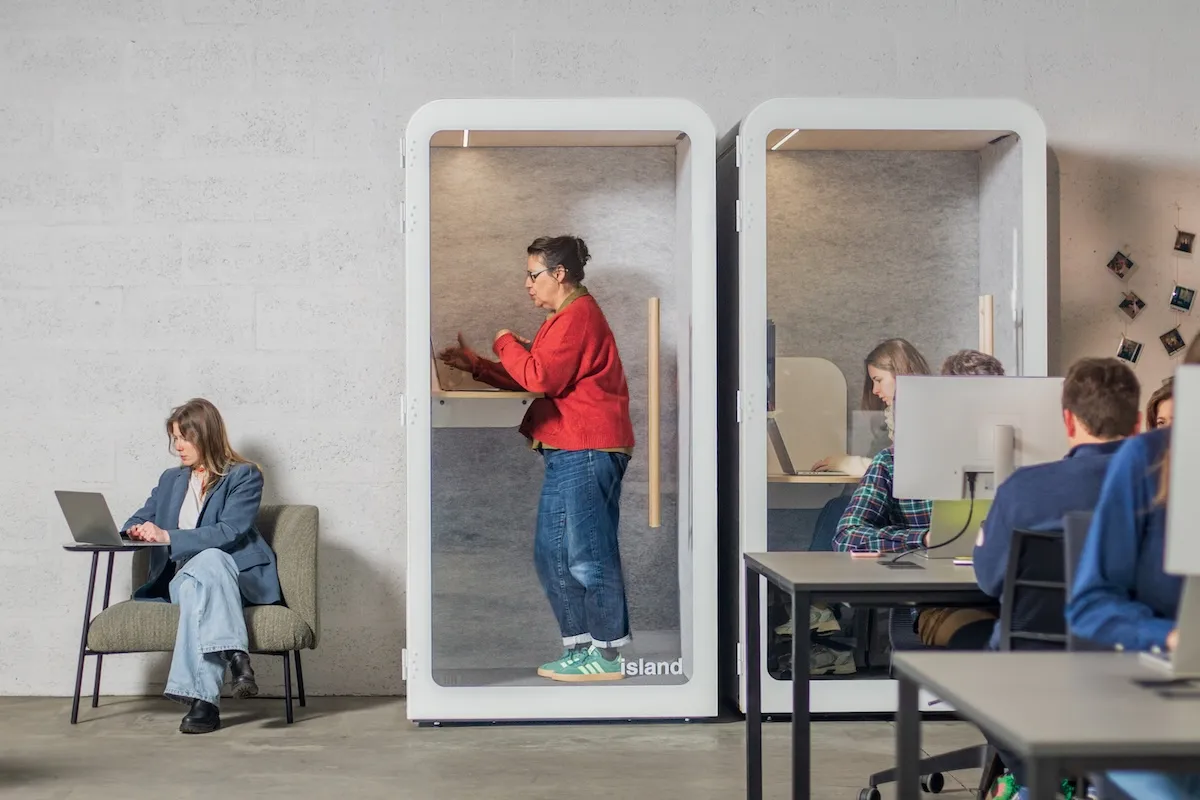
Open-plan offices present specific challenges for installing acoustic pods. Placing them along the perimeter limits visual distractions while creating pockets of calm without fragmenting the collaborative space.
Avoid high-traffic zones that generate constant interruptions. The goal is to create an environment conducive to concentration without partitioning off the open feel of the workspace.
“The office is a huge open-plan space, so we need to be able to step away easily and quickly. For example, founders who are in the middle of fundraising often have calls where it’s essential to speak in a quiet, uninterrupted environment.”
Pauline Mielczarek
Office and event manager at Hexa
This testimonial highlights the importance of immediate accessibility in these dynamic environments. The office acoustic pod needs to fit naturally into the daily workflow to encourage spontaneous adoption by teams.
Optimizing Visual Integration
Aesthetic integration directly influences how well users accept the acoustic pod. Blending it with the existing design creates visual coherence that eases adoption.
Preserve natural light by avoiding blocking main light sources. A poorly positioned pod can darken a space and create psychological resistance to using it. Respect the room's architectural sightlines to maintain visual flow.
This attention to aesthetic detail protects your investment and reinforces the company's modern image.
Common Placement Mistakes in Open-Plan Offices:
Central positioning that fragments the space
Blocking main walkways
Installing facing screens, creating distractions
Neglecting natural light
Installation in Traditional Offices and Coworking Spaces
Partitioned Offices and Hybrid Spaces
Traditional offices offer more flexibility for installing acoustic pods. Make use of blind spots and underused areas to create concentration zones without reducing usable workspace.
Create transition zones between private and shared spaces. The acoustic pod can serve as an airlock between different work environments, easing the psychological transitions needed for concentration.
Optimizing available space becomes crucial in offices where every square meter counts. Thoughtful installation maximizes usefulness without compromising circulation.
Specifics of Coworking Spaces
Coworking spaces present unique challenges around managing traffic from multiple companies. Positioning needs to allow for fair, shared use among all occupants.
Provide clear signage and visible usage rules to avoid conflicts over use. The office acoustic pod becomes a shared resource that needs collaborative management.
In coworking spaces, installing the acoustic pod near relaxation areas encourages its use for confidential calls between meetings. This proximity encourages spontaneous use while preserving quiet in silent work zones.
Acoustic pod solutions need to adapt to the diversity of needs in these multi-use environments
Good to Know
Only 12 pods have been returned after the 100-day trial since Work With Island began — a testament to post-installation satisfaction and to how well-chosen the locations were.
Positioning a pod facing screens creates constant visual distractions that undermine its effectiveness. Screen movement and brightness disrupt users' concentration.
Avoid placing pods near dining areas, which generate smells, foot traffic, and informal conversations. These sensory disturbances reduce the appeal of the concentration space.
Placement in air-conditioning drafts creates thermal and acoustic discomfort. Temperature swings and ventilation noise disrupt the optimal work environment.
Optimizing Team Adoption
Training users on proper use maximizes the effectiveness of your investment. Explain the features, booking rules, and best practices for use.
Install clear signage and visible usage rules. This communication eases adoption and prevents conflicts over use between colleagues.
Tracking occupancy rates provides valuable data to optimize placement or justify installing additional pods.
“We chose Work With Island booths because they offer excellent value for money. The team was flexible, agile and very responsive during both delivery and installation.”
Cyrille Picard
Technical Manager at Siemens
Post-Installation Best Practices:
Initial team training
A simple booking system, if needed for your organization
Collecting usage feedback
Adjustments based on needs
Evolving and Reconfiguring Your Installation
The demountable, reassemblable design of Work With Island pods makes frequent space reorganizations easier for modern businesses. This flexibility protects your investment during moves or restructuring. Installation with no construction work, in around 30 minutes, lets you reposition your acoustic podsas your needs evolve.
Moving without damage preserves the value of your equipment. This technical feature sets professional solutions apart from traditional fixed installations. A simple 220V outlet is all it takes to bring your acoustic pod back into service in a new location.
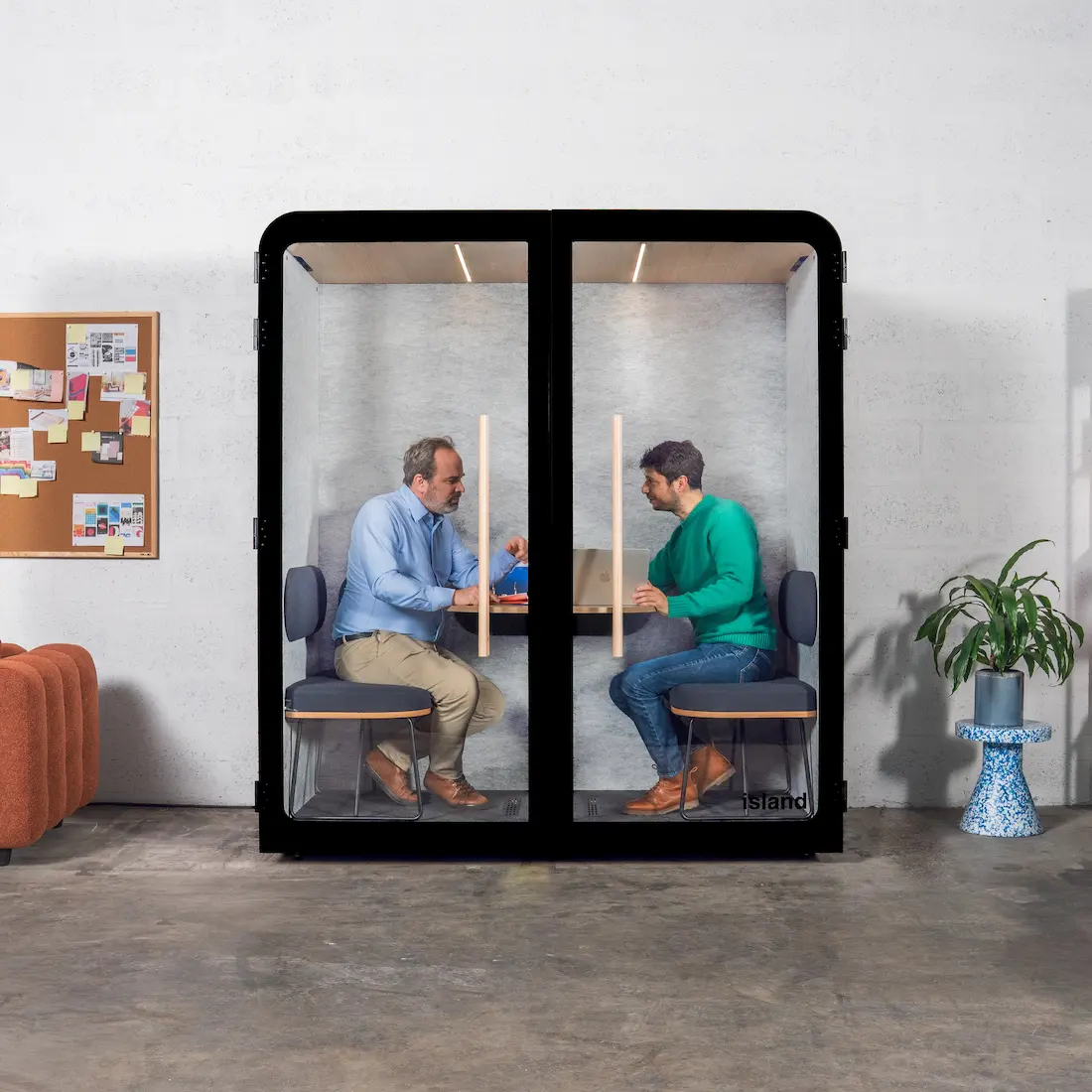
Evolving needs may call for moving from an individual pod to collaborative solutions. The Work With Island range supports this natural progression, from the Island Solo for individual calls to the Island Quattro for team meetings.
Adding pods as teams grow can be done progressively. This modular approach avoids over-investing upfront while ensuring a controlled scale-up, particularly through leasing, which spreads out the investment.
Ongoing optimization based on usage feedback refines placement and maximizes effectiveness. The 100-day trial period lets you validate your location choices under real conditions before committing.
Work With Island Supports You in Your Installation Project
Work With Island offers a full range of acoustic pods designed by a B Corp-certified company with the Origine France Garantie label. From the Island Solo at £3,990 for individual needs to the Island Quattro at £9,990 for team meetings, our solutions adapt to every workspace.
Our technical expertise is built on more than 15,000 pods installed, with a team of 40 international staff who understand the specifics of every work environment. This hands-on experience guarantees relevant advice for your installation.
Performance certified to the ISO 23351-1 standard delivers noise reduction of up to 31 dB. This effective sound insulation suits most installation contexts, from open-plan offices to traditional offices.
“The real strength of Work With Island is their ability to move quickly at every stage, from the commercial side to logistics, ensuring the acoustic pods are installed smoothly and without any hassle.”
Maxime Cohendet
Co-founder at Wefy Group
Want to learn more about our acoustic pods?
Fill out the form and receive our product guide right away. A clear PDF containing all the essential information: price, dimensions, connectivity, etc.
Frequently Asked Questions About Office Acoustic Pods
Can I install an acoustic pod myself?
Self-installation is possible thanks to the kit-based design. However, we recommend professional support to optimize positioning for your specific environment and guarantee optimal acoustic performance.
How long does it take to install an acoustic pod?
Full installation takes about 30 minutes, including electrical hookups and performance checks.
Can an acoustic pod be moved after it's assembled?
Yes, the demountable design allows for full relocation. This flexibility is especially useful during space reorganizations or moves, without compromising the equipment's integrity.
What distance should be kept from existing workstations?
We recommend a minimum of 1.5 meters from main walkways and 3 meters from noisy equipment to optimize acoustic effectiveness and user accessibility.
How do I choose between several possible locations?
The analysis should factor in foot traffic, ambient noise levels, accessibility, and visual integration. Our team offers a free audit to identify the optimal location for your specific constraints.
.svg)
.svg)
.svg)
.svg)





.webp)



.webp)

.webp)