Understanding the acoustic challenges of modern open-plan offices
The open-plan office has become the norm in many modern companies. Promising more collaboration and better use of space, this layout still comes with a major challenge: noise. A large majority of employees in open-plan offices see noise as the top daily source of discomfort. It's not just a matter of comfort, it's a matter of performance and wellbeing.
The impact of noise on work performance
The hidden cost of noise is considerable. Noise interruptions cause significant losses in concentration. Multiply that by several interruptions a day, and the impact becomes alarming.
Prolonged exposure to noise also causes chronic stress. The brain, constantly working to filter out irrelevant sound, wears itself out. This sensory overload can have long-term health effects. Companies also see a link between noisy environments and higher absenteeism.
How workspaces are evolving, and what's needed now
The history of workspaces reflects how our relationship with work has changed:
- 1950s-1960s: enclosed offices, symbols of hierarchy
- 2000s: large open floors representing transparency and collaboration
- Today: a more nuanced approach that recognises how varied individual needs are. To understand this transformation of workspaces over the centuries in more depth, see our blog article on the history and evolution of workspaces leading to the open-plan office
Hybrid work, accelerated by the pandemic, has reshaped our expectations. Employees, having experienced the calm of working from home, come back to the office more sensitive to noise. They now look for spaces that combine the social benefits of the office with the quiet needed to focus.
Types of work pod for the open-plan office
Faced with these challenges, acoustic work pods have emerged as the preferred solution. These pockets of calm come in several formats to meet specific needs, creating an effective acoustic barrier with no major structural work.
Individual pods for focus
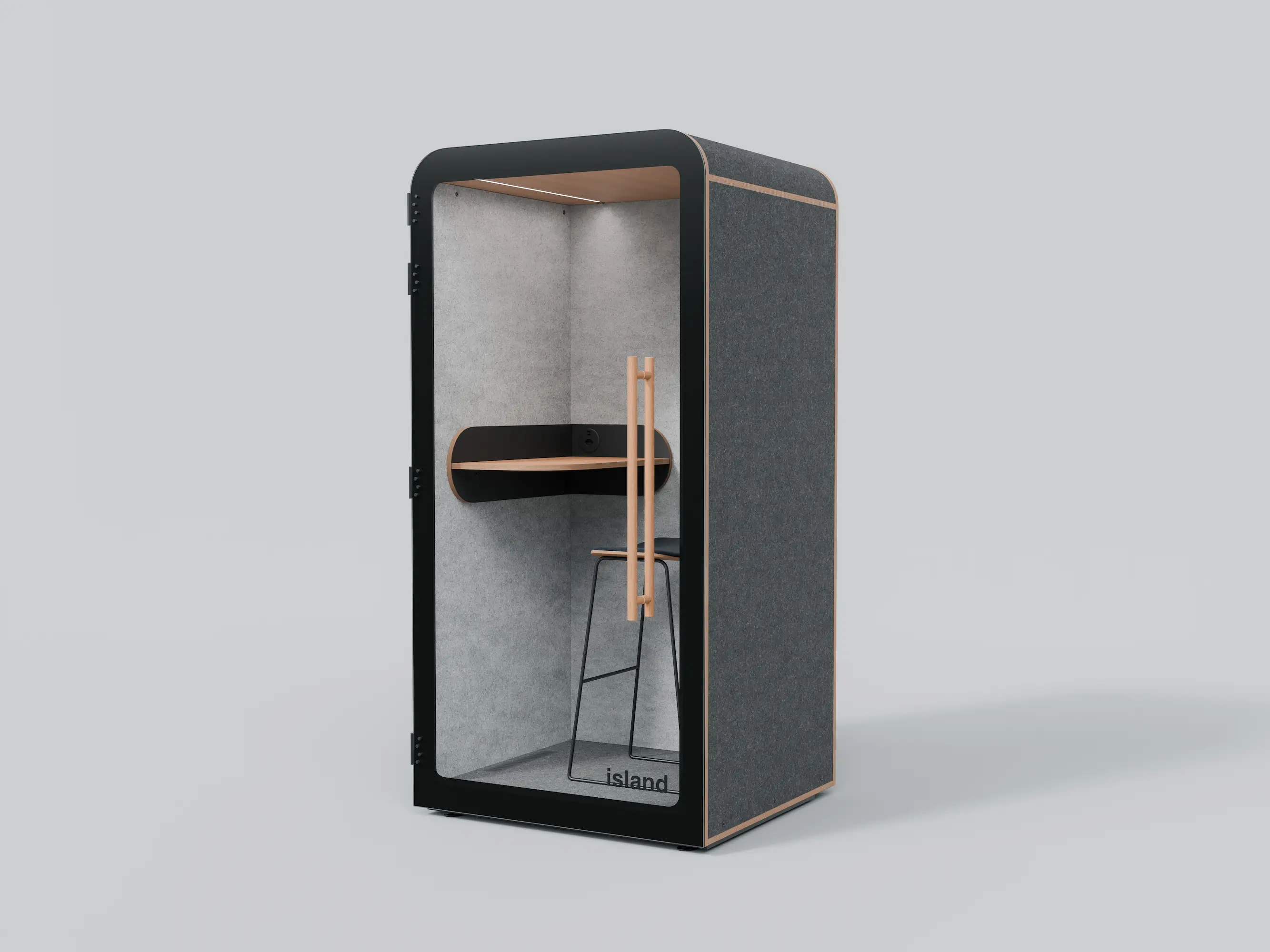
Individual pods offer an ideal retreat for tasks that need intense focus or confidential calls. With a compact footprint (around 1 m²), they fit easily into existing spaces.
Work With Island's Island Solo offers an impressive 30.2 dB of sound reduction (Class A to ISO 23351-1). These pods include a high-performing ventilation system (400 m³/h), LED lighting with presence detection, and full connectivity (220V socket, USB-A, and USB-C).
For longer sessions, the Island Desk offers a built-in seat with two types of foam for optimal comfort. Typical use for these pods ranges from phone calls to video meetings, and tasks that need sustained concentration.
Pods for 2-3 people
For small-group conversations, pods like the Island Duo offer an ideal balance between privacy and collaboration. With a comfortable interior, they host face-to-face meetings with no sense of being cramped.
These spaces stand out for their versatility. Fitted with comfortable seating and richer connectivity (2 220V sockets, USB-A, USB-C), they support both confidential interviews and brainstorming sessions. Their acoustic performance stays excellent, with 28.7 dB of sound reduction.
The major advantage of these pods lies in how effectively they replace small traditional meeting rooms, while offering unmatched flexibility in where they're placed.
Acoustic meeting pods (4-7 people)
For larger team meetings, pods like the Island Quattro are a credible alternative to conventional meeting rooms. These spaces, which comfortably seat 4 people, offer a generous interior volume while keeping a reasonable floor footprint.
Acoustic performance and technical specifications
To make an informed choice, it helps to understand the metrics that define a work pod's acoustic performance.
Understanding acoustic performance indicators
The benchmark for assessing, and especially comparing, an office pod's acoustic performance is ISO 23351-1.
Work With Island pods are certified Class A for the Solo (-30.2 dB) and Desk (-31.1 dB), and Class B for the Duo (-28.7 dB) and Quattro (-29.8 dB).
Other indicators exist too, but on their own they don't tell you enough about a complete pod:
- NRC (Noise Reduction Coefficient): shows how well a material absorbs sound (useful for understanding one component, but not for comparing a whole pod).
- STC (Sound Transmission Class): measures how well a structure or wall limits sound transmission (useful for construction elements, but not very representative of a finished pod with its door, seals, and ventilation).
In practice, when deciding and comparing pods, start with ISO 23351-1, since it's the only approach that's genuinely comparable and lab-verified. The other indicators mainly serve as background context.
Materials and sound insulation technology
Acoustic effectiveness relies on a strategic combination of materials with complementary properties:
- Open-cell acoustic foam: absorbs mid and high frequencies
- Acoustic glass: layers separated by PVB films that dissipate sound energy
- Composite materials: create a mass-spring-mass effect that works well against low frequencies
Ventilation and thermal comfort
Acoustics is only one dimension of overall comfort. Air renewal is just as crucial. The ventilation systems in Work With Island pods deliver 400 m³/h for individual models and up to 800 m³/h for multi-person pods.
These systems work through quiet extraction, creating a slight negative pressure that draws in fresh air through inlets designed to minimise acoustic leaks.
Fitting work pods into your open-plan office
How well an acoustic solution works also depends on how thoughtfully it's fitted into the overall workspace.
Strategic placement of pods in the open-plan office
Optimal positioning comes from studying foot traffic and activity zones. Ideally, map the space's acoustics, identifying the naturally noisy areas and the quieter ones.
How visible the pods are matters a great deal for actual use. Too isolated, and they risk being underused; too exposed, and they lose their character as a retreat. Finding the balance usually means positioning them around the edges of the main work areas.
For spaces hosting different teams, the geographic spread of pods should reflect where the need is greatest, creating natural micro-zones within the open-plan office.
Creating a balanced work ecosystem
Work pods are just one part of a broader acoustic strategy. They work well alongside other measures, like suspended acoustic panels or absorbent flooring.
Acoustic zoning of the open-plan office is a particularly effective approach. By clearly defining collaboration zones and focus zones, you create an implicit framework that guides behaviour.
Adopting these new spaces often needs a bit of support. Clear usage guidelines support fair, effective use. Some companies choose digital booking systems to optimise use.
Aesthetic customisation and company identity
How the pods look contributes significantly to how well they fit in. Beyond their acoustic function, these elements become architectural markers that can reinforce a company's visual identity.
Customisation options include the choice of exterior colours, interior finishes, and sometimes branding elements. Matching the overall design of the space is essential.
Benefits of work pods beyond acoustics
While sound insulation is the primary function of work pods, their benefits go well beyond that.
Privacy and information security
In an open-plan office, it's often hard to hold a confidential conversation without being overheard: a client call, a sensitive point with a manager, an HR interview, a legal discussion, a negotiation, and so on. An acoustic pod creates a dedicated space that greatly reduces how far voices carry, letting you speak more freely without hunting for a meeting room for every conversation.
The result: conversations stay more private, people feel more at ease, and the team gains a little more day-to-day peace of mind, especially when the topics are sensitive or personal.
Impact on wellbeing and employee satisfaction
Having control over one's workspace is a key factor in job satisfaction. Pods answer this fundamental need for autonomy, letting employees choose their environment based on their task.
Employees with acoustic isolation options report lower stress levels and higher job satisfaction compared to those working exclusively in an open-plan office with no alternative.
Adapting to organisational change
Spatial flexibility is the most strategic long-term advantage of work pods. Where reorganisations are frequent, these mobile structures are a lasting investment, unlike fixed construction.
At around 280 kg for the Island Solo and 500 kg for the Island Quattro, these solutions stay movable with no major work. This lets organisations try out different layouts and adapt their environment as they learn what works.
Download our product guide for the dimensions, weight, and options available for our pods.
Choosing the right acoustic work pod
With so many solutions on the market, choosing the right pod takes a methodical look at several criteria.
Cost-benefit analysis and ROI
Investing in acoustic pods is a significant financial commitment. This budget should be weighed against traditional alternatives and their own constraints.
Compared to traditional fit-out work, pods offer the advantage of a well-controlled total cost. Their installation needs no structural changes to the building, avoiding the hidden costs often linked to construction work.
For organisations hesitant about the upfront investment, Work With Island offers flexible financing options. Long-term rental, from €68 a month for an Island Solo, spreads the financial load while you benefit immediately.
Assessing quality and durability
A pod's durability depends largely on build quality and the materials used. The warranty offered is a good indicator: Work With Island offers a 5-year warranty against any functional defect.
Where a product is made also shapes its quality. Products made in France, like Work With Island's, generally benefit from high production standards and a reliable supply chain.
Resistance to heavy use is a key factor. Friction points like hinges, handles, and ventilation systems should be designed to withstand thousands of use cycles.
Features and connectivity
The quality of the user experience depends largely on the built-in features. Every Work With Island pod includes at least a 220V power socket, USB-A, and USB-C.
Specific equipment options like the Video Conferencing Pack (€1,190 excl. VAT) improve the experience for particular uses, especially hybrid meetings.
Trends and innovation in work pods
The acoustic pod market is evolving fast, driven by technology and new ways of working.
Smart work pods
IoT technology is gradually turning pods into connected, smart spaces. Occupancy sensors collect precise data on usage patterns, helping organisations optimise their pod fleet.
Integration with space-booking systems is the most impactful day-to-day development. Exterior touchscreens showing occupancy status and allowing instant booking are becoming standard.
Eco-responsible solutions
Environmental impact is becoming a dominant factor in the decision. Manufacturers are responding by developing pods that use recycled, recyclable materials.
Optimising energy use is another major area of innovation. Low-power LED lighting with presence detection is now standard across all Work With Island solutions.
Adapting to hybrid work
Hybrid work has become the dominant model since the pandemic. Pods are evolving to meet the specific needs of this new pattern, particularly by improving the video meeting experience.
Remote booking systems are becoming an essential feature. Being able to book a pod from home meets hybrid employees' need for predictability.
Testimonials and case studies
The real-world experience of organisations that have rolled out work pods offers valuable lessons.
Transforming an open-plan office in the tech sector
A Paris-based software company transformed its workspace by adding 8 individual pods (Island Solo) and 4 meeting pods (Island Duo). The initial problem was clear: a large majority of developers reported difficulty concentrating.
The results, measured six months after installation, speak for themselves:
- A significant drop in noise-related complaints
- A notable rise in satisfaction with the workplace
Fitting into a financial services environment
For a financial consulting firm, the main challenge was privacy in a strict regulatory context. The solution combined 6 individual pods (Island Desk) and 2 meeting spaces (Island Quattro).
Beyond stronger regulatory compliance, the organisation observed:
- Better client relationships, with contacts appreciating the call quality
- Less stress for consultants, freed from the worry of exposing confidential information
Feedback from everyday users
Feedback from equipped companies shows very concrete benefits, beyond the theory:
At RATP Real Estate, the initial need was simple: a genuine space to step away for calls. After installation, the pods became part of daily life, used every day by the teams.
At Siemens, adoption was tracked through an internal rating system: the pods scored 4.6/5, with feedback like "we need more", a sign they meet a real need.
At Hexa, the main value people mention is being able to step away quickly for important conversations, sensitive calls, moments that need calm and no interruptions.
Work With Island acoustic work pods are much more than a simple technical answer to the noise problem. They reflect a way of thinking about work that recognises how varied individual needs are, and the need for spaces suited to different tasks. Their growing adoption reflects a real shift in how we think about workplaces, now designed to balance wellbeing, performance, and flexibility.