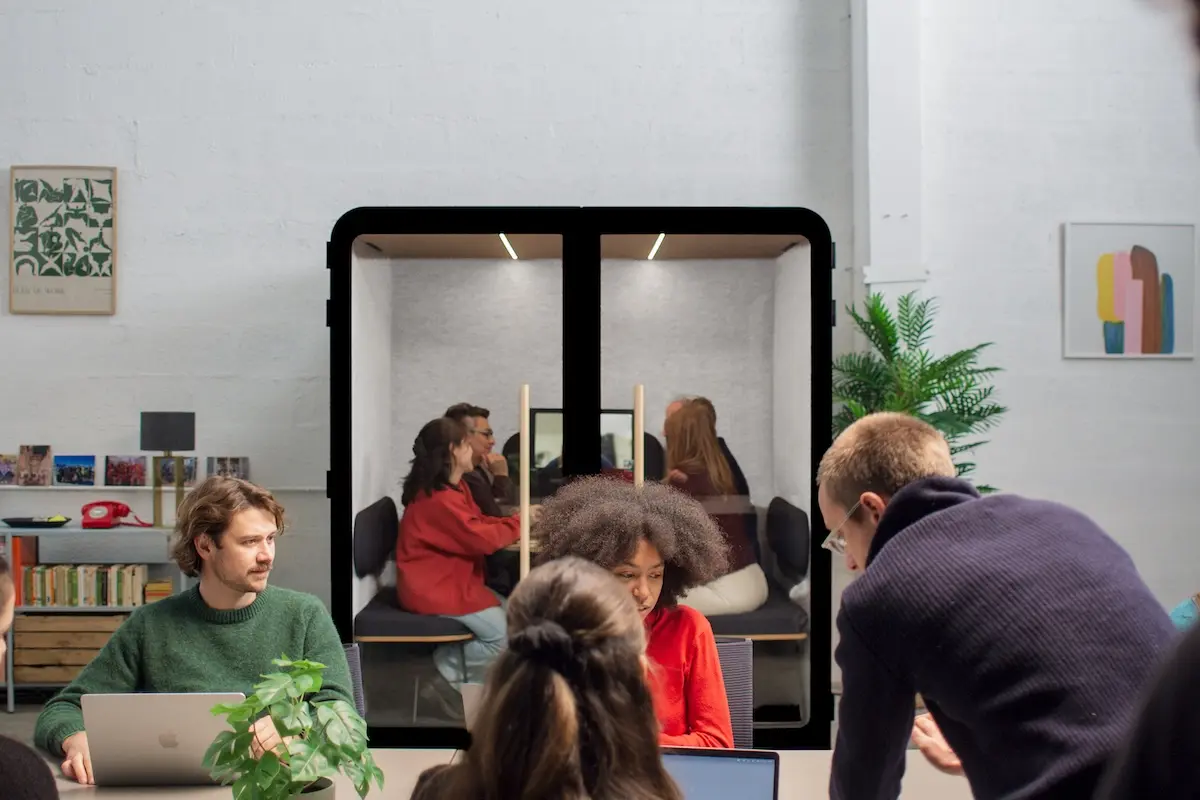
This complete guide walks you through the different acoustic pod solutions for turning your open-plan office into an optimal work environment. You'll find the key selection criteria, the technical side of installation, and the concrete benefits for your organisation.
The different types of acoustic pods for open-plan offices
The acoustic pod market now offers a wide range of solutions to meet the different needs of collaborative workspaces.
Individual pods (phone boxes)
Phone boxes are the most common solution for creating individual focus spaces. These office acoustic pods offer sound insulation of 28.7 to 31.1 dB under the ISO 23351-1:2020 standard, turning a noisy environment into a quiet space.
With an optimised footprint of around 1 m², these individual pods serve multiple purposes: confidential phone calls, video calls, intense focus sessions, or recording content. An Island Solo reduces ambient noise from 70 dB to 42 dB, creating an environment comparable to a library.
Standard equipment typically includes automatic LED lighting, silent ventilation with air renewed every 15 seconds, and full connectivity (power and Ethernet outlets). Adjustable feet make installation easy on any type of flooring.
Collaborative pods (2 to 4 people)
Collaborative acoustic booths create dedicated workspaces for informal meetings and small-group discussions. These meeting pods come with advanced equipment: multiple power outlets, USB-A and USB-C ports, network connectivity, and optional integrated screens.
Installing 12 Duo pods at Siemens led to a satisfaction score of 4.6/5 in an internal survey. Employees particularly value being able to hold confidential conversations or bring remote colleagues into meetings without disrupting the rest of the office.
Their flexible layout means these spaces can adapt as organisational needs change. The 4-person models offer enough room for brainstorming sessions or client meetings in a quiet, professional setting.
Open acoustic booths
This semi-open solution focuses on blending visually into the existing open-plan office. The open pod design keeps the sense of open space while still cutting down targeted background noise.
These installations work particularly well where visual oversight still matters, or where the building's structure limits fully enclosed solutions.
Selection criteria for your office acoustic pod
Choosing a professional acoustic pod means weighing up several technical and organisational criteria to make sure it fits your specific needs.
Acoustic performance and certifications
The ISO 23351-1 standard is the international benchmark for evaluating the sound insulation of acoustic pods. This certification guarantees that tests were carried out in an accredited laboratory using standardised protocols.
A reduction of 28.3 dB concretely turns a 70 dB environment (a noisy open-plan office) into a quiet 42 dB space, equivalent to a library. This performance allows for optimal focus and professional-quality phone calls.
Certified professional acoustic pods use materials tested and validated for their absorption and sound insulation properties. Being transparent about this technical data is a sign of a serious manufacturer and genuine product performance.
Dimensions and fitting into the space
For a 200 m² open-plan office, the recommended ratio is 1 pod per 15 desks, so 3 to 5 pods depending on the layout. This proportion meets demand without creating queues or long waits.
Accessibility for people with reduced mobility should be considered from the design stage, particularly for collaborative pods. Your office layout needs to preserve existing walkways while making the most of these new spaces.
Equipment and connectivity
Automatic, silent ventilation is a critical element of user comfort. A flow rate of 400 m³/h with air renewed every 15 seconds guarantees good air quality even during extended use.
The integrated LED lighting should adjust automatically to occupancy and offer a colour temperature that helps focus. Power outlets and network connectivity allow the use of computer and video-call equipment.
Our 7 years of hands-on experience across more than 4,000 installations means we can recommend technical specifications that are proven in the field. The furniture inside (tablets, seating) needs to combine ergonomics with resistance to heavy use.
Checklist for auditing your needs:
- Assess current noise levels (decibel measurement)
- Analyse foot traffic and circulation zones
- List electrical and network requirements
- Check architectural constraints (ceiling height, floor load)
Installing and laying out your acoustic booths
Setting up booths calls for a methodical approach so they blend in well with your existing work environment.
Preparation and technical constraints
Looking at the building's structure beforehand helps identify specific technical constraints. A standard 220V supply is usually enough, but you should check how close an outlet is and whether there's network access.
Fire safety rules call for M1-rated (non-flammable) materials and clear evacuation routes. Modern acoustic pods are designed with these constraints in mind from the outset.
Installing an acoustic pod takes under an hour with no major construction work, thanks to adjustable feet that compensate for uneven floors. Our experience across more than 15,000 installations confirms how simple this is in practice.
Choosing the right spot
Where you position your booths directly affects how much they get used. Keeping enough distance from busy walkways limits visual and acoustic disruption. Natural and artificial light should be considered to avoid glare on glazed surfaces.
Circulation around the installations needs to stay easy. An open-plan coworking space needs a balance between how accessible the pods are and preserving shared space.
Maintenance and upkeep
Surfaces are cleaned with standard office cleaning products. The materials chosen withstand heavy use and keep their appearance over time.
Periodic checks on the ventilation keep air renewal performance up. Checking the electrics and connectivity is part of the standard preventive maintenance for any workspace.
Our maintenance guide, built on 7 years of product experience, sets out the upkeep steps that preserve acoustic performance and the durability of the installations.
Installation checklist:
- Check electrical and network constraints
- Measure the available space precisely
- Confirm delivery access
- Plan the installation (4 hours per pod)
- Train users on the equipment
Benefits of acoustic pods for productivity
The impact of acoustic solutions on organisational performance shows up in several concrete productivity and wellbeing indicators.
Impact on focus and wellbeing
Reduced noise-related stress is the first benefit reported by acoustic pod users. Their effectiveness noticeably improves the quality of conversations and creates decompression spaces that are essential in demanding work environments.
The decompression spaces created by the pods let employees recharge between demanding tasks. This wellbeing function helps reduce mental fatigue and maintain a high level of performance throughout the day.
Confidentiality and conversation quality
Protecting sensitive conversations meets companies' confidentiality requirements, particularly around GDPR compliance for personal data. Client phone calls benefit from clearer audio, which improves the organisation's professional image.
A 90% reduction in interruptions during client calls, observed at RATP Real Estate, shows the concrete impact on operational efficiency. This translates into better client satisfaction and faster handling of requests.
Acoustic phone pods remove noise disruption in both directions: the user is no longer disturbed by their surroundings, and their conversations no longer disturb colleagues nearby.
Flexibility and scalability
Reorganising without construction work is a major advantage given how often organisations change. Adapting to headcount changes just means moving or adding modules as needed.
Return on investment is calculated across several components: productivity gains, lower stress-related absenteeism, and better talent retention.
Modular office furniture allows for constant scalability without becoming obsolete. This flexibility is a real strategic asset for growing or transforming companies.
Measurable performance indicators:
- Reduced noise-related stress (satisfaction surveys)
- Better quality client calls
- Fewer interruptions and disruptions
- Higher reported levels of concentration
- Stronger employer brand
Price and budget for your pods and booths
Being upfront about costs and financing options makes it easier to decide and to fit the purchase into your office fit-out budget.
Price ranges by model
1-person pods range from €3,990 to €4,790 excl. VAT depending on the equipment included. The Solo starts at €3,990 excl. VAT, while the Desk version with its comfortable bench seat reaches €4,790 excl. VAT.
2-person pods start at €7,990 excl. VAT for the standard Duo model. This configuration suits interviews, one-to-one meetings and confidential conversations between colleagues.
4-person pods start at €9,990 excl. VAT for the Quattro model. This solution suits team meetings, brainstorming sessions and client meetings in a professional setting.
Options and customisation
Integrated screens add €490 excl. VAT to the total. This turns the pod into a proper video-call space with good image quality.
Video-call packs at €1,390 excl. VAT include a camera, directional microphones and speakers built for remote conversations. It's a turnkey solution for hybrid working.
Financing solutions
Leasing starts at €68/month and spreads the investment over up to 60 months. This preserves cash flow while still allowing you to deploy acoustic solutions right away.
The free 100-day trial lets you confirm the fit with your real needs before committing to a purchase. Only 12 pods have been returned out of more than 15,000 installations, which speaks to how well our solutions match what companies actually need.
The manufacturer warranty covers manufacturing defects and includes preventive maintenance. This contractual protection safeguards your investment and keeps the acoustic performance intact over time.
Standards and regulations for acoustic spaces
The regulatory framework and certifications ensure acoustic solutions are compliant and perform as expected in professional settings.
Acoustic standards and certifications
The ISO 23351-1 standard is the international benchmark for evaluating acoustic pods. This certification guarantees tests carried out in accredited laboratories using standardised, repeatable protocols.
The Origine France Garantie certification confirms French manufacturing and compliance with national quality standards. This label meets the expectations of companies that value short supply chains and traceability in their purchases.
The PEFC label for wood and B Corp for social commitment reflect a responsible approach to design and production. These certifications meet the CSR criteria of modern organisations.
Fire safety and accessibility
Materials rated M1 (non-flammable) comply with fire safety requirements for premises open to the public. This classification ensures compliance with French risk-prevention regulations.
Ventilation compliant with ERP standards (premises open to the public) guarantees the air renewal needed for user comfort and safety. These technical specifications are checked by inspection bodies on all our large corporate projects.
Environmental responsibility
Using recyclable materials is part of a circular-economy approach. The modular design makes it easy to take components apart and reuse them at end of life.
Local manufacturing reduces the carbon footprint tied to transport and supports the national economy. This approach supports companies' environmental commitments and CSR certification requirements.
B Corp certification recognises our commitment to positive social and environmental impact. This international label validates our approach to sustainable development and social responsibility.
Work With Island supports your project
Work With Island designs and manufactures acoustic pods to turn your open-plan office into an optimal work environment. Our Island range (Solo, Desk, Duo, Quattro) covers every sound-insulation and collaboration need.
Our certified acoustic performance reaches -31.1 dB under the ISO 23351-1 standard, ensuring effective noise reduction in any professional setting. This expertise is built on 7 years of research and development in applied acoustics.
Recognised technical expertise
More than 15,000 pods installed across Europe since 2018 reflect our expertise and the trust our clients place in us. Our 4.9/5 satisfaction rating confirms the quality of our products and customer service.
Just 12 returns during the 100-day trial period show how well our solutions match what companies genuinely need. This reflects the relevance of our use-focused approach.
Certified French manufacturing
Our pods carry the Origine France Garantie label and B Corp certification, obtained in 2025. This dual certification reflects both manufacturing quality and our commitment to environmental and social responsibility.
French production ensures full traceability of our products and compliance with the most demanding quality standards. This proximity also means faster after-sales support and more room to customise solutions.
Excellent customer service
Delivery within 6 to 8 weeks anywhere in Europe keeps your project on schedule. Installation in one hour with no major construction work keeps disruption to your business to a minimum.
Our acoustic experts offer personalised support from your initial audit through to commissioning. This consultative approach ensures the solution deployed is a perfect match for your needs.
.svg)
.svg)
.svg)
.svg)