The main sources of noise in the workplace
Precisely identifying noise sources is the first step to improving your office acoustics. Our on-site acoustic measurements reveal three main categories of disturbance that affect your teams daily.
High ceilings with no acoustic treatment turn offices into a sound box. This architectural configuration can increase perceived noise levels by 5 to 8 dB compared with a properly treated space.
Human sources
Workplace architecture naturally amplifies or dampens sound. The absence of sound-insulating partitions favours noise travelling long distances. Reflective materials like glass and concrete create reverberation that prolongs every noise disturbance.
Conversations between colleagues are the top source of disturbance in open-plan offices. In a space with 50 people, the noise level can permanently reach 65 dB, equivalent to a busy street. Phone calls generate peaks between 60 and 65 dB, while informal chats range between 55 and 60 dB.
Architectural sources
Impromptu meetings amplify this disturbance. Every spoken exchange creates a domino effect: nearby employees instinctively raise their voices to compensate for ambient noise, generating a noise spiral that's hard to control.
Phone rings create abrupt interruptions with peaks that can reach 75 dB. These sudden intensity changes are more disruptive than constant noise, because they demand attention unpredictably.
Technical and equipment sources
Office equipment contributes significantly to background noise. A laser printer generates peaks of 70 dB while printing, disrupting focus within a 5-metre radius. Air conditioning maintains a constant background noise of 45 to 50 dB, while IT equipment adds another 3 to 5 dB.
The impact of noise on employees' physical and mental health
The consequences of office noise on your employees' health are documented by numerous scientific studies. The INRS, the leading French body on occupational health, identifies measurable impacts from as low as 50 dB of continuous exposure.
Effects on physical health
Auditory fatigue is the first warning sign. 45% of employees exposed to more than 55 dB continuously report frequent headaches, according to a 2022 INRS study. This fatigue shows up as a feeling of blocked ears by the end of the day and heightened sensitivity to sound.
Muscle tension results from the physiological stress generated by noise exposure. Neck and shoulder muscles unconsciously tense up to "filter out" disturbance. This constant tension causes neck pain in 38% of open-plan office employees.
Sleep problems show up even after the working day is over. The auditory system, overstimulated for 8 hours, struggles to regain balance. 32% of employees exposed to noise report trouble falling asleep linked to auditory hypervigilance.
Psychological consequences
Chronic stress is the most worrying psychological impact. Cortisol, the stress hormone, rises by 30% after 2 hours of exposure to a noisy environment, according to the WHO. This hormonal rise keeps the body in a permanent state of alert, depleting mental resources.
Irritability rises in proportion to noise level. Conflicts between colleagues increase by 23% in offices exceeding 60 dB. This friction stems from the cognitive fatigue generated by the constant effort of filtering out background noise.
Anxiety builds gradually in noise-sensitive employees. Anticipating disturbance creates a vicious cycle: fear of noise amplifies the perception of sound and reinforces the stress felt.
Impact on quality of work life
Quality of work life significantly deteriorates in noisy environments. Absenteeism rises by 15% in offices exceeding 65 dB, according to our analysis of client data. Employees develop avoidance strategies, arriving later or leaving earlier to escape noise peaks.
Turnover accelerates in teams exposed to noise. 28% of resignations explicitly mention noise as a reason for leaving. This staff turnover generates hidden recruitment and training costs.
Job satisfaction drops by 40% when noise levels exceed 60 dB. This dissatisfaction affects team engagement and motivation to perform in a hostile environment.
Consequences for productivity and focus
The economic impact of office noise is directly measurable in your teams' performance. Studies from the University of California, Irvine, demonstrate quantifiable productivity losses starting at 55 dB of exposure.
Loss of focus and efficiency
Cognitive interruptions caused by noise fragment attention. It takes an average of 23 minutes to regain focus after a noise interruption above 55 dB. This figure reveals the scale of the productivity loss: in a noisy environment, an employee can only maintain focus in short bursts.
Refocus time varies with task complexity. Demanding intellectual tasks need up to 35 minutes to refocus after a significant noise disruption. This duration explains why open-plan office employees report a sense of unfinished work by the end of the day.
Errors increase by 12% in sound environments exceeding 60 dB. This rise comes from attention being split between the main task and unconsciously filtering out noise. The brain, working on two fronts, makes more mistakes.
Measurable economic impact
Productivity losses range from 15 to 20%, depending on the intensity of the disturbance. A company with 100 employees loses an average of €180,000 a year because of noise, a calculation based on average salary and measured productivity loss. This conservative estimate doesn't account for indirect costs.
Project delays pile up in teams exposed to noise. Fragmented attention extends design and validation timelines. Review phases need 25% more time to identify errors caused by noise interruptions.
Hidden costs include more sick leave, staff turnover and lower creativity. These factors, hard to quantify, often equal the direct productivity loss.
Communication difficulties
Misunderstandings multiply in noisy environments. Employees compensate for background noise by speaking louder, creating a cacophony that hurts the precision of exchanges. 18% of project errors stem from misunderstandings linked to noise.
Having to repeat things slows down decision-making. Every important piece of information needs to be rephrased several times to be properly understood. This redundancy consumes 15% more time in open-plan office meetings.
Vocal fatigue affects 42% of open-plan office employees. The constant effort to be heard over ambient noise puts excessive strain on the vocal cords, causing hoarseness and voice loss by the end of the day.
Regulation and employer obligations
The French legal framework imposes precise obligations on office noise. The Labour Code and AFNOR standards define the thresholds to respect and the mandatory steps for protecting your employees.
The Labour Code and applicable standards
Article R4213-6 of the Labour Code states that work premises must be designed to avoid disturbing noise. This general obligation is refined by the NF S31-080 standard, which recommends not exceeding 55 dB for office work, under AFNOR standards.
Regulatory thresholds vary with the type of activity. For intellectual tasks requiring focus, the limit drops to 50 dB. Shared offices allow up to 55 dB, while circulation spaces accept a maximum of 60 dB.
Regulation distinguishes permanent background noise from occasional noise peaks. Interruptions exceeding 65 dB are considered disruptive, even if the average remains acceptable. This nuance recognises the specific impact of intensity variations on focus.
Responsibilities and penalties
The employer has a duty to achieve results in protecting against noise. This responsibility involves proactively assessing risks and putting suitable prevention measures in place. Ignoring noise disturbance doesn't exempt them from this obligation.
Including noise in the single occupational risk assessment document (DUERP) becomes mandatory as soon as employees report disturbance. This formalisation engages the employer's liability and opens the door to corrective actions.
Penalties can include administrative fines and civil liability claims if there's proven impact on employee health. Case law is increasingly recognising noise-related stress as a factor in professional unfitness.
Mandatory assessment process
Professional acoustic measurements are the first step in the assessment. These readings need to be taken at ear height (1.2 m) at representative workstations, across several time slots to capture daily variations.
The GABO questionnaire (Acoustic Disturbance in Open-Plan Offices) complements the technical approach with a subjective assessment. This standardised tool measures employee perception and identifies the noise sources users find most problematic.
The action plan follows directly from these assessments. It prioritises interventions by urgency and potential impact, sets an implementation timeline and includes regular follow-up on the effectiveness of the solutions deployed.
Collective solutions for reducing noise disturbance
Improving your office acoustics requires a comprehensive approach combining acoustic treatment, space reorganisation and modular solutions. Our experience from more than 10,000 installations lets us identify the most effective interventions.
Acoustic treatment of spaces
Installing absorbent panels is the first intervention to consider. These elements reduce noise levels by 8 to 12 dB depending on the space's configuration. Wall panels treat lateral reflections, while suspended elements control vertical reverberation.
Sound-insulating partitions create physical barriers between workstations. These separations, even partial ones, reduce noise propagation by 10 to 15 dB. Their effectiveness depends on height (at least 1.6 m) and the density of the material used.
Acoustic ceilings turn your office's largest surface into an absorbent element. This comprehensive intervention improves overall acoustics and reduces auditory fatigue for the whole team. The investment pays for itself quickly through improved productivity.
Reorganising the workplace
Acoustic zoning separates activities by noise level. "Quiet" spaces host focus tasks, while "collaborative" zones allow for spoken exchanges. This spatial organisation reduces usage conflicts and improves comfort for everyone.
Optimised circulation limits movement through quiet work zones. Peripheral corridors channel foot traffic and preserve the calm of central workstations. This attention to movement flow reduces interruptions by 30%, according to our observations.
Spaces dedicated to phone calls free workstations from work conversations. These specialised zones, even small ones, concentrate noise disturbance and preserve the acoustic quality of other spaces.
Acoustic pods and isolated spaces
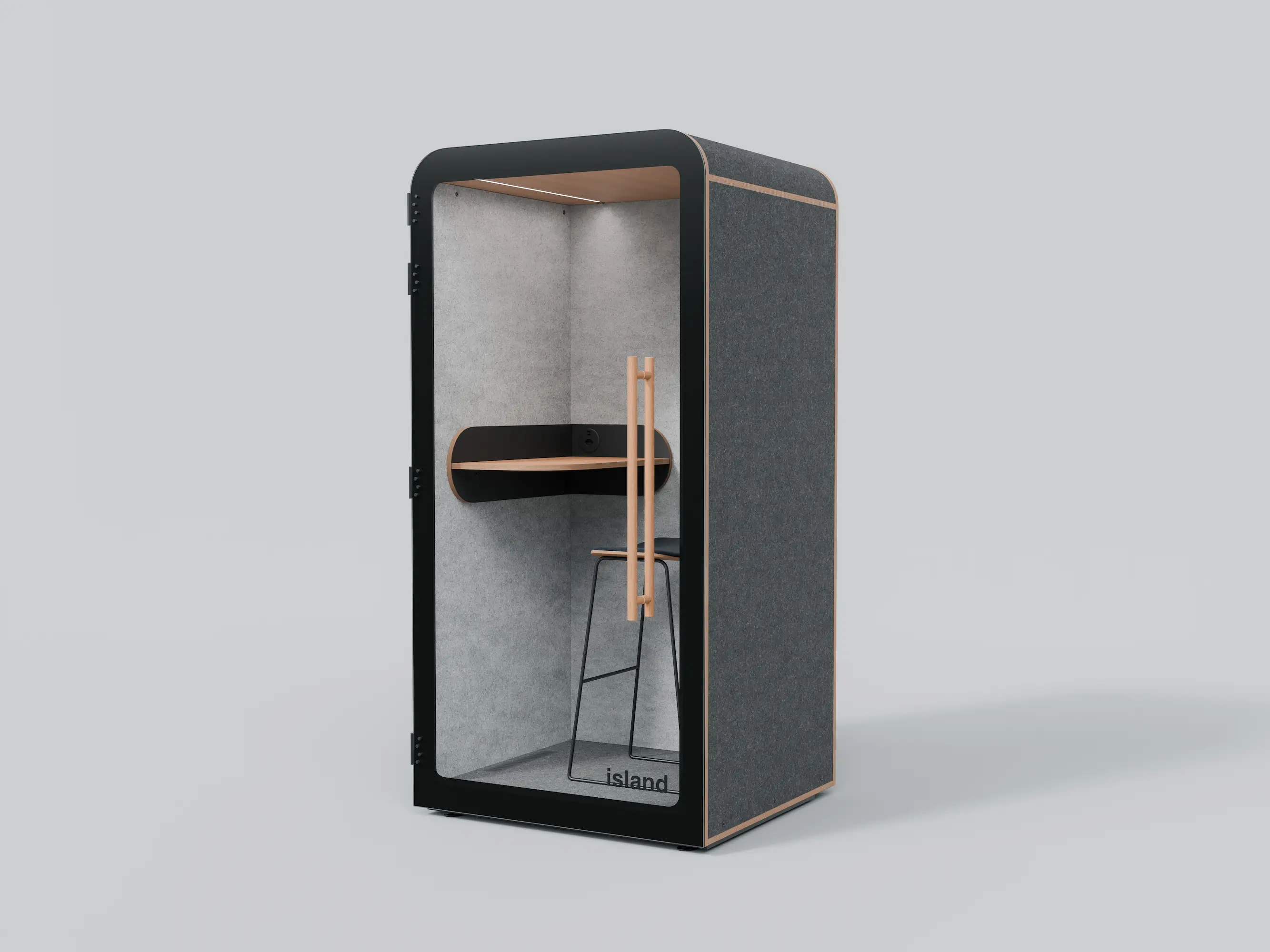
Acoustic pods offer a modular solution with no major construction work. An acoustic pod offers noise reduction of -28.7 to -31.1 dB, creating an optimal workspace for demanding tasks. This performance transforms a 65 dB open-plan office into a quiet 35-40 dB space.
Installation with no construction work preserves the existing layout while creating isolated spaces. These modular solutions adapt as the company evolves and can be moved as needed. This flexibility is a major advantage given how often offices are reorganised.
Versatile use maximises the return on investment. Pods accommodate individual work, confidential calls, video calls or interviews alike. This adaptability meets the varied needs of modern teams.
Individual measures and best practices
Improving the sound environment also means adopting individual and collective best practices. These measures, simple to implement, effectively complement technical solutions.
Sound etiquette rules
A code of conduct raises your teams' awareness of the impact of noise on their colleagues. This document formalises expected behaviour: using silent mode, moving away for personal calls, keeping voice volume down. Collective buy-in amplifies the effectiveness of every individual effort.
Dedicated call spaces channel phone conversations out of focus zones. This simple arrangement reduces interruptions by 40%, according to our client feedback. Clearly designating these spaces makes it easier for employees to adopt them.
"Quiet" slots from 2pm to 4pm support post-lunch focus. This time window, naturally suited to individual work, becomes an acoustic refuge for demanding tasks. A 3-month trial lets you adjust based on specific needs.
Individual solutions
Noise-cancelling headphones are the most accessible form of protection. Active noise-cancelling headphones can reduce noise exposure by 15 to 25 dB. This individual solution gives personal control over the acoustic environment and adapts to varying sensitivities.
Adjusting workstation layout optimises position relative to noise sources. Facing away from high-traffic zones reduces the perception of conversations by 5 to 8 dB. Screens positioned as a visual barrier also limit auditory distraction.
Focus techniques help maintain attention despite noise disturbance. The Pomodoro technique structures work into 25-minute blocks, the optimal period before auditory fatigue sets in. This time-based approach partly offsets the impact of noise on productivity.
Training and awareness
Awareness workshops educate your teams on the physiological impact of noise. This scientific understanding motivates the adoption of best practices and justifies acoustic investments. A 2-hour training session generates lasting behavioural change.
Training managers equips them to identify and address acoustic problems. These frontline relays quickly detect problematic situations and point towards the right solutions. Their involvement guarantees the effectiveness of collective measures.
Internal communication keeps up acoustic vigilance over time. Regular reminders, team testimonials and shared best practices sustain the improvement momentum. This ongoing engagement prevents individual efforts from slipping.
Best practices you can apply right away:
- Turn on silent mode on all equipment
- Use dedicated spaces for phone calls
- Keep voice volume down in shared zones
- Batch print jobs to limit disturbance
- Position noisy equipment on the periphery
- Hold meetings in enclosed spaces
Work With Island supports your acoustic project
Work With Island offers a full range of acoustic pods designed to address office noise challenges. Our Island Solo, Desk, Duo and Quattro offer isolated workspaces with -28.7 to -31.1 dB of noise reduction under the ISO 23351-1 standard (Class A for the Solo and Desk, Class B for the Duo and Quattro).
Our 100% French manufacturing in the Vendée region, with B Corp certification, guarantees quality and environmental responsibility. This eco-responsible approach fits the CSR values of your fit-out projects.
Our proven expertise rests on more than 15,000 pods installed for 4,000 clients (Engie, Decathlon, LVMH, SNCF). This experience lets us adapt our solutions to any professional environment and guarantee their effectiveness.
Installation with no construction work, and our exceptional client satisfaction with a 4.9/5 Google rating, reflect the quality of our products and our clients' trust in our acoustic solutions.
As Jérôme Bourdon of WiiSmile confirms: "What our employees told us: noise is wearing and tiring. They need moments to recharge, to settle down and step away. The pod lets you step away completely, into a zero-decibel atmosphere."
Want to create calmer workspaces for your teams? Contact Work With Island for a free acoustic assessment and discover our solutions tailored to your environment.