To remember
70% of noise comes from conversations, not equipment
In an open-plan office with 50 people, a phone call can be heard up to 8 metres away. Impromptu meetings generate peaks of 70 dB. Open architecture amplifies everything through reverberation.
The NF S31-080 standard sets 50 dB(A) for intellectual work
Open-plan offices: 55 dB is the regulatory limit, 50 dB is recommended for comfort. Beyond that, noise must be included in the DUERP risk assessment and corrective measures put in place.
23 minutes to regain focus after a noise interruption
Productivity drops by 66% in a noisy environment, and mistakes increase by 40%. An open-plan office exceeding 55 dB engages the employer's legal liability (French Labour Code, Article R4213-5).
Acoustic pods: -28.7 to -31.1 dB, no construction work, in 1 hour
ISO 23351-1 certified, Class A (Solo/Desk) or Class B (Duo/Quattro). From €3,990 to €9,990 excl. VAT. Leasing from €68/month. Client rating: 4.6/5 at Siemens after installation.
The main sources of noise in workspaces
Understanding where office noise comes from is the first step to effectively solving acoustic problems. Our audits show that noise sources fall into several distinct categories, each requiring a specific approach.
Human noise and conversations
Conversations are the main source of disturbance in 70% of the cases we handle. Discussions and phone calls generate an average of 60 to 65 decibels, equivalent to a normal face-to-face conversation. This intensity may seem moderate, but it becomes a problem in a workplace where focus is essential.
In an open-plan office with 50 people, a phone call can be heard up to 8 metres away, according to our acoustic measurements. Employees are subjected to constant noise pollution that fragments their attention and reduces their cognitive efficiency.
Impromptu meetings amplify this phenomenon. Unlike individual phone calls, they involve several people at once and generate noise peaks of up to 70 decibels. These noise interruptions create a domino effect that disrupts the entire workspace.
Equipment and furniture noise
Office equipment contributes significantly to ambient noise. A laser printer generates an average of 55 dB on standby and 70 dB in operation, according to INRS data. Photocopiers easily reach 75 to 80 decibels during large print runs, creating particularly disruptive noise peaks.
Air conditioning and ventilation systems produce a constant ambient noise, often underestimated but ever-present. This permanent background noise, even at low intensity, contributes to auditory fatigue and employee stress.
Unsuitable furniture adds another dimension to noise disturbance. Squeaky chairs, slamming drawers and mechanical keyboards create a cacophony of small, repetitive noises that build up over the course of the day.
Main noise sources and their levels:
- Phone calls: 60-65 dB
- Printers in operation: 70-80 dB
- Air conditioning: 45-55 dB (constant)
- Photocopiers: 75-80 dB
- Mechanical keyboards: 50-60 dB
- Phone rings: 70-85 dB
- Footsteps in corridors: 55-65 dB
- Opening/closing drawers: 50-70 dB
The impact of noise on productivity and health
The consequences of office noise go far beyond simple discomfort. Our client feedback and scientific studies both point to a major impact on cognitive performance and team wellbeing.
Effects on cognitive performance
A University of Sydney study reveals a 66% drop in focus in a noisy environment. This decline comes with a 40% increase in errors, particularly visible in tasks requiring precision and sustained attention.
The most worrying phenomenon concerns recovery time after an interruption. An accountant interrupted by a phone call takes an average of 23 minutes to get back to their initial level of focus. This explains why productivity drops drastically in noisy environments.
At Siemens, our acoustic pods scored 4.6/5 in the post-installation evaluation. Employees report a notable improvement in their ability to focus on complex tasks and a significant reduction in errors in their work.
The cumulative effect of these noise interruptions creates a vicious cycle. Employees develop avoidance strategies like using headphones or seeking out isolated spaces, which further fragments how work gets organised.
Impact on health and wellbeing
Noise generates chronic stress that companies often underestimate. This prolonged exposure causes auditory fatigue, which shows up as headaches, irritability and a general decline in workplace wellbeing.
Sleep problems affect 35% of employees exposed to high noise levels at work. This accumulated fatigue directly affects their performance the next day and creates a vicious cycle of stress and exhaustion.
At WiiSmile, before we stepped in, employees said: "noise is wearing and tiring. They need moments to recharge, to settle down and step away." This quote from Jérôme Bourdon, co-founder, perfectly illustrates the psychological effect of noise on teams.
Absenteeism rises by 10% in particularly noisy open-plan offices, according to our observations. This correlation is explained by accumulated stress and the gradual deterioration of working conditions.
Want to know more about our soundproof booths?
Get our product guide by email. A clear, complete document with dimensions, weight and available options for our soundproof booths.
Download the product guide
Why modern architecture amplifies the problem
Architectural trends over the past few decades have favoured aesthetics and space optimisation at the expense of office acoustics. This trend largely explains the explosion of noise problems in contemporary workplaces.
Open-plan offices are a direct result of removing traditional partitions. This layout allows sound to travel freely in every direction, creating an acoustic environment that's particularly unfavourable for intellectual work.
Hard materials like concrete, glass and steel amplify reverberation. An open-plan office with a 2.5 m concrete ceiling generates a reverberation time of 1.2 seconds, against the 0.6 seconds recommended by the ISO 3382 standard. This difference roughly doubles how long sounds linger in the space.
Ceiling height is a critical factor that's often overlooked. Spaces under 3 metres high create an acoustic confinement effect that concentrates noise and prevents it from dissipating naturally.
In our audits, 70% of companies exceed the recommended occupancy density of 10 m² per person. This overcrowding mechanically multiplies simultaneous noise sources and creates a particularly problematic build-up effect.
The 5 most common architectural mistakes:
- Removing all partitions with no acoustic compensation
- Using only hard, reflective materials
- Insufficient ceiling height (< 3 metres)
- Excessive occupancy density (< 8m² per person)
- No acoustic transition zones
Insulation and acoustic fit-out solutions
Solving office noise problems requires a technical approach suited to each situation. Our experience from more than 10,000 installations lets us recommend the most effective solutions based on each environment's specific constraints.
Acoustic surface treatment
Wall acoustic panels are the first line of defence against reverberation. With an absorption coefficient of 0.8 to 0.9, they significantly reduce echo and improve speech clarity. Installing wall panels reduces noise levels by an average of 8 to 12 dB, according to our post-installation measurements.
Absorbent suspended ceilings effectively complement wall treatment. Their strategic position intercepts sound waves before they reflect, limiting noise propagation across the space. This solution proves particularly effective in high-density spaces.
Suitable flooring like carpet or acoustic tiles reduces impact noise. This measure, often overlooked, noticeably improves acoustic comfort, particularly in high-traffic areas.
Partitions and private spaces
Movable acoustic partitions offer layout flexibility while guaranteeing 25 to 35 dB of noise reduction. This temporary solution allows for quickly adapting the acoustic layout to specific needs.
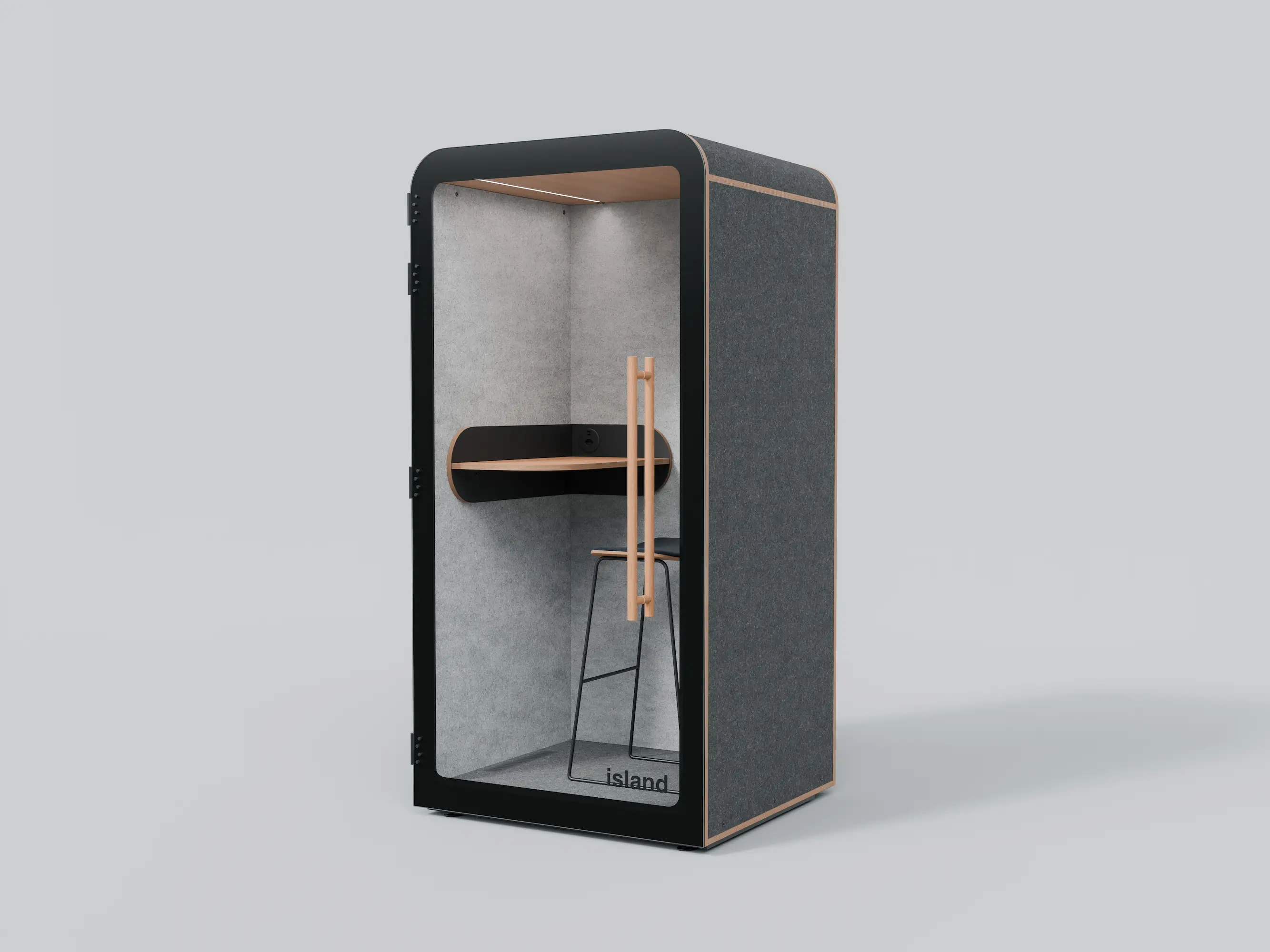
Individual phone booths are the most effective solution for isolating conversations. Our Island pods let you go from 65 dB in the open-plan office to 37 dB inside, creating a genuine haven of calm for tasks that need focus.
Soundproof meeting spaces protect confidential discussions while also preserving the calm of the wider environment. This dual function optimises space use while solving acoustic problems.
Sound masking and pink noise
Sound masking uses white or pink noise to mask unwanted conversations. The optimal frequencies sit between 125 and 4,000 Hz, with a recommended level of 42 to 48 dB.
This technique reduces conversation intelligibility by 70% with no extra disturbance. Sound masking proves particularly effective in spaces where traditional office sound insulation isn't enough.
Organising spaces to limit disturbance
Optimising acoustic layout can significantly reduce noise disturbance without heavy investment. This organisational approach effectively complements technical solutions and maximises their impact.
Smart acoustic zoning separates quiet zones for focus work from dynamic spaces reserved for collaboration. This functional separation limits noise spread and preserves pockets of calm for intellectual work.
Positioning noisy equipment on the periphery keeps noise sources away from main workstations. This simple but effective arrangement reduces noise exposure for the whole workforce.
Creating transition spaces or acoustic airlocks dampens noise spreading between zones. These buffer spaces, even small ones, significantly contribute to improving overall acoustic comfort.
At RATP Real Estate, reorganising the space along these lines led to a 40% drop in noise-related complaints. "We chose Work With Island pods because they offer great value for money. The team showed flexibility, agility and responsiveness," says Etienne Joly, branch manager.
Anti-noise furniture uses existing elements as natural acoustic screens. A 1.8 m bookshelf reduces noise propagation by 5 to 8 dB, according to our measurements. This cost-effective approach makes the most of what's already there before considering further investment.
Adding plants to the workplace provides natural absorption while improving the overall aesthetic. Plants absorb some sound waves and help create a calmer environment.
Our expertise, built on more than 10,000 installations, confirms the effectiveness of these organisational approaches, particularly when they're part of a broader acoustic improvement strategy.
Sound etiquette rules and awareness
The human factor is often the most effective and most cost-effective lever for reducing office noise. Raising team awareness and setting clear rules durably transforms behaviour and the sound environment.
A sound-usage charter sets precise rules for phone calls, favouring dedicated spaces or isolation solutions like our acoustic pods. Formalising this avoids conflict and clarifies behavioural expectations.
Managing conversations and impromptu meetings requires a balanced approach between spontaneous collaboration and respecting quiet. Setting up specific time slots and zones preserves team dynamics while protecting individual focus.
Raising awareness of unintentional noise often reveals unsuspected sources of disturbance. Employees become aware of the impact of their behaviour and naturally adapt their habits.
At Engie, introducing an acoustic charter led to a 60% reduction in noise-related conflicts. This dramatic improvement demonstrates the effectiveness of behavioural approaches when they come with strong backing from leadership.
Awareness sessions on the effects of noise educate teams on the physiological and psychological consequences of noise disturbance. This awareness encourages buy-in for new rules and their spontaneous application.
Training managers in acoustic management gives them the tools to identify problems and propose suitable solutions. These internal champions amplify the effectiveness of actions and ensure they last.
The 10 rules of sound etiquette:
- Use dedicated spaces for phone calls
- Keep conversation volume down
- Avoid long discussions near workstations
- Use headphones for audio content
- Close drawers and doors gently
- Schedule noisy equipment for quiet hours
- Respect quiet zones
- Report acoustic issues
- Adapt behaviour to the ambient activity level
- Favour written messages for one-off exchanges
Work With Island supports your acoustic project
Work With Island offers professional acoustic pods for durably solving office noise problems. Our Island Solo, Desk, Duo and Quattro offer turnkey soundproof spaces, with no construction work or disruption. Each model meets specific needs, from individual privacy to team meetings.
Our B Corp certification attests to our environmental and social commitment. Our pods meet the highest quality standards, with 100% French manufacturing in the Vendée region that guarantees traceability and durability.
Our proven expertise rests on more than 15,000+ pods installed for 4,000 prestigious clients like Engie, Decathlon, LVMH and L'Oréal. With a satisfaction rate of 4.9/5, we demonstrate the reliability of our solutions.
Our full service includes delivery within a few weeks anywhere in Europe, a 100-day trial to confirm the solution is the right fit, a 5-year warranty and support from a team of 40 specialists. This comprehensive approach secures your investment and guarantees your satisfaction.
"Work With Island's great strength is this ability to respond, from the sales side right through to logistics, to install the pods smoothly and simply," says Maxime Cohendet, co-founder of Wefy Group.
Looking for an effective solution against office noise? Contact Work With Island for a free acoustic assessment and discover our ISO 23351-1 certified pods (Class A for the Solo and Desk, Class B for the Duo and Quattro).
“Merci beaucoup à Work With Island qui fabrique les meilleures phone booth rapport qualité-prix ! L’esthétique est tout aussi réussie, l’accord bois/feutre s’accorde parfaitement dans tous les espaces de bureaux que j’ai pu aménager.”
Jérôme Bourdon
Co-founder of WiiSmile
Frequently asked questions
What's the noise standard for offices?
The French standard recommends a maximum noise level of 45-50 dB for offices, under the NF EN ISO 3382 standard. The Labour Code sets maximum exposure at 85 dB over 8 hours. For optimal intellectual work, continuous noise shouldn't exceed 50 dB. A professional acoustic assessment lets you precisely evaluate your environment.
How do you measure noise at work?
Use a certified sound level meter to measure noise in dB(A) at several points during the day. Measurements should be taken at ear height (1.2 m) and at different workstations. The assessment should include the equivalent level (LAeq), noise peaks and reverberation time. Our experts carry out full acoustic audits with professional equipment.
What solutions exist for open-plan office noise?
Several complementary approaches: installing wall and ceiling acoustic panels, creating soundproof spaces (phone booths), reorganising furniture, and setting up sound-etiquette rules. Acoustic pods offer an immediate solution with no construction work. The right choice depends on your budget, layout and technical constraints.
How much does an office noise solution cost?
Costs vary by solution: acoustic panels (€50-150/m²), movable partitions (€300-800/m²), acoustic pods (€3,990-9,990 excl. VAT depending on capacity). Our Island range offers complete solutions with financing options available. A free assessment lets you evaluate the optimal budget for your needs and constraints.
Can I reduce noise without major construction work?
Absolutely. Our acoustic pods are installed with no construction work in under 1 hour, plug into a standard outlet and can be moved. Other no-work solutions: acoustic furniture, freestanding panels, reorganising spaces, usage rules. Effectiveness depends on the existing layout and the noise sources identified.
Are acoustic solutions really effective?
Yes, with measurable results: our pods achieve -31.1 dB of noise reduction (certified ISO 23351-1, Category A). Among our clients, we see an average satisfaction improvement of 85%. Effectiveness depends on the initial assessment and how well the solution is matched to the need. Our 100-day trial guarantees your satisfaction.