How does the brain process noise and focus?
The auditory cortex and selective attention
The auditory cortex plays a crucial role in our ability to focus. When our brain perceives surrounding sounds, it automatically activates a filtering mechanism to distinguish important information from background noise. This selective-attention function is put under particular strain in noisy environments.
Recent studies on brain activity in open-plan offices show that cognitive overload occurs when the auditory cortex must process several sound sources at once. Participants exposed to high noise levels show a notable decline in performance on tasks requiring sustained focus.
This cognitive overload directly affects working memory, reducing our ability to process and retain complex information. Cognitive neuroscience confirms that prolonged noise exposure impairs the neural connections responsible for focus.
The difference between white noise and noise distractions
White noise fundamentally differs from noise distractions in its regularity and uniform frequency spectrum. Unlike conversations or notifications, white noise can support focus in some people by masking disruptive sound variations.
Tolerance thresholds vary from person to person. Some people have particular auditory sensitivity, needing especially quiet workplaces to maintain optimal productivity.
The scientific impact of noise on productivity
Data on productivity loss
The figures leave no doubt: noise significantly affects productivity. Studies reveal a major drop in productivity in noisy open-plan offices. At the same time, noise exposure raises stress through elevated cortisol, the stress hormone.
Another critical indicator: it takes a considerable amount of time to regain focus after a noise interruption. This explains why work sessions in open-plan offices are often fragmented and inefficient.
As Jérôme Bourdon, co-founder of WiiSmile, puts it: "What our employees told us: noise is wearing and tiring. They need moments to recharge, to settle down and step away. The pod lets you step away completely, into a zero-decibel atmosphere."
This client observation perfectly reflects the feedback we regularly receive from our European clients.
The physiological effects of noise
Prolonged noise exposure triggers a cascade of harmful physiological reactions. Elevated cortisol disrupts not only immediate focus but also sleep quality, creating a vicious cycle of cognitive fatigue.
Physical symptoms of acoustic stress include:
- Muscle tension and headaches
- Higher blood pressure
- Digestive problems
- Irritability and anxiety
Our feedback after installing acoustic pods shows a notable improvement in users' physiological wellbeing, confirming the positive impact of a calm environment.
Types of noisy environments and their specifics
Shared spaces and open-plan offices
Shared spaces present particular acoustic challenges. Phone calls are the main disruptor, generating unpredictable noise peaks that abruptly interrupt focus cycles. The "cocktail party" effect amplifies this phenomenon: our brain instinctively latches onto partial conversations, even when we're trying to focus on something else.
Our acoustic analysis of workspaces reveals noise levels that vary throughout the day. These constant variations prove more disruptive than a stable background noise, because they permanently strain our attention system.
Noisy open-plan environments also create a vocal escalation effect: the louder the atmosphere, the louder employees speak, worsening overall noise pollution.
Work-specific noise sources
Beyond conversations, many pieces of equipment contribute to office noise pollution. Printers, ventilation systems and digital notifications create a constant background noise that tires the ear.
Our experience shows that the combination of these sources creates a particularly stressful workplace, even when each source individually stays within acceptable thresholds.
Technology solutions for improving focus
Acoustic pods and sound insulation
Acoustic pods are an effective solution for treating office noise. They offer certified sound insulation, with performance reaching up to 31.1 dB under the ISO 23351-1 standard. This significant reduction transforms a noisy environment into a calm space.
Installation with no construction work is a major advantage of these modern solutions. In under an hour, a focus space can be created with no disruption to teams and no changes to the building's structure. This flexibility allows for quick adaptation to organisations' evolving needs.
Estela Sánchez, wellbeing manager at Seedtag, confirms: "The pods have improved our workspace by taking pressure off our large meeting rooms, while still allowing for impromptu calls."
This installation perfectly illustrates the adaptability of these B Corp and Origine France Garantie certified solutions.
Sound-masking technology
White noise systems offer a complementary approach for improving focus. These devices generate a uniform sound spectrum that masks surrounding distractions without creating new noise pollution.
Apps and noise-cancelling headphones are effective individual solutions, particularly for tasks requiring intense focus. However, they don't solve the collective problem of shared workplaces.
Innovation in optimised acoustic ventilation deserves particular attention. Modern systems maintain optimal comfort without generating noise disturbance, demonstrating that acoustic performance and air quality can go hand in hand.
Practical methods for optimising your sound environment
Optimising the sound environment requires a comprehensive approach combining spatial layout and behavioural change. Acoustic zoning is the first step: physically separating focus zones from collaboration spaces significantly reduces distractions.
Absorbent materials play a crucial role in controlling noise levels. Acoustic panels, carpets and movable partitions help reduce reverberation and create pockets of calm. Strategically positioning workstations, avoiding direct proximity to high-traffic zones, considerably improves acoustic comfort.
Our fit-out expertise with thousands of companies shows that spatial organisation can significantly reduce noise pollution with no major investment.
Behavioural techniques complement this approach. Introducing silent-communication protocols, such as favouring instant messaging tools, reduces vocal interruptions. Setting focus time slots, during which conversations are limited, lets everyone benefit from periods of deep work.
Introducing acoustic charters perfectly illustrates this collaborative approach. This initiative, based on raising awareness and training teams, leads to a notable reduction in noise-related complaints.
Work With Island supports your acoustic project
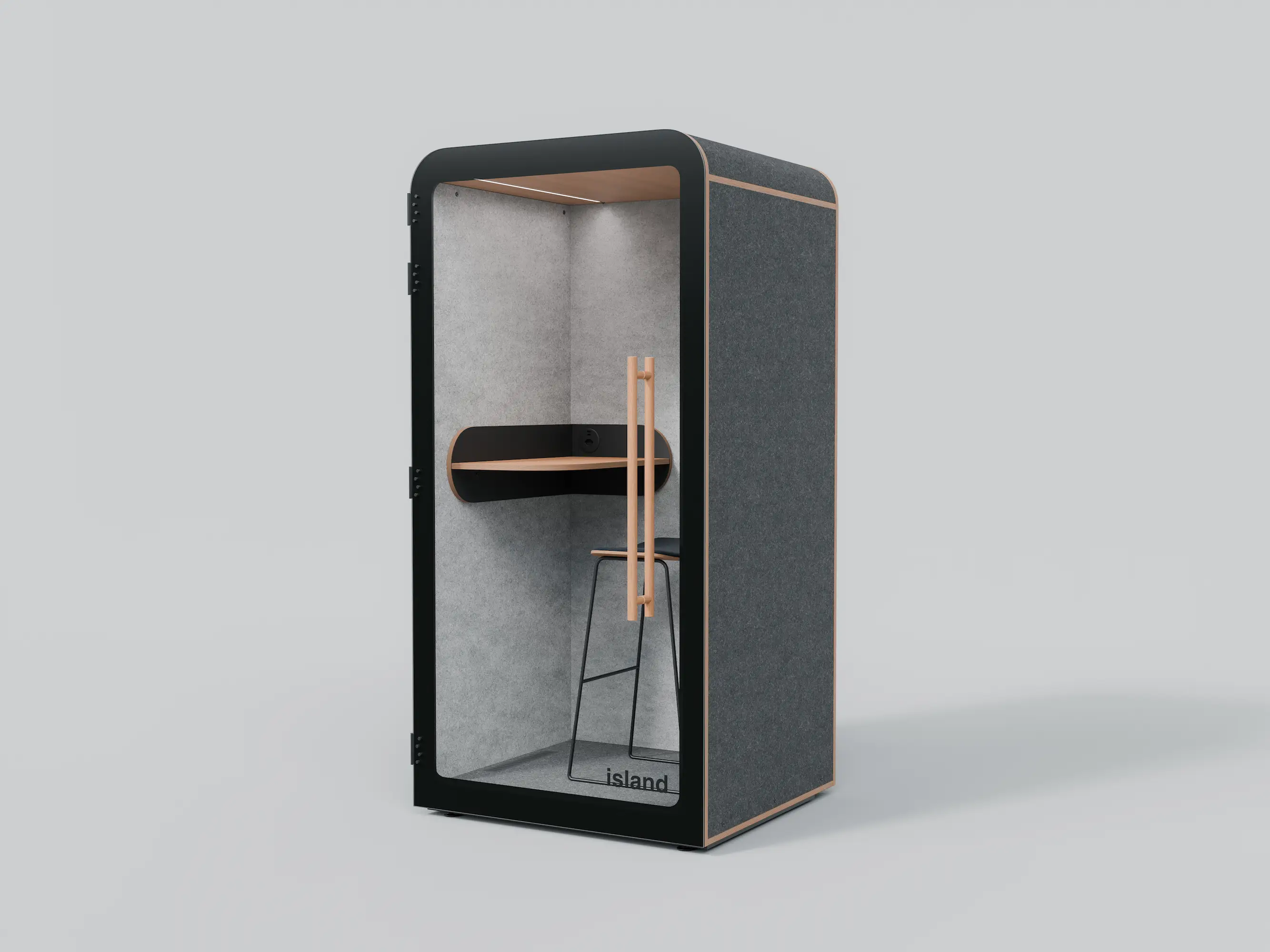
Work With Island designs and manufactures certified acoustic pods to transform your workplace. Our Island Solo, Island Desk, Island Duo and Island Quattro offer certified sound insulation of up to 31.1 dB under the ISO 23351-1 standard.
What sets us apart
What sets us apart rests on three fundamental pillars. Our B Corp certification since 2025 reflects our responsible commitment, while the Origine France Garantie label ensures manufacturing in the Vendée region with eco-responsible materials.
Express installation in under an hour, with no construction work or disruption, meets the operational constraints of modern companies. This flexibility, combined with the ability to easily move our pods, adapts to frequent office reorganisations.
Our models and performance
.svg)
.svg)
.svg)
.svg)







.png)