To remember
Noise is costly: to health and to the business
The WHO finds that prolonged exposure above 55 dB raises cardiovascular risk. In open-plan offices, productivity drops by 15% and absenteeism rises to 34%, versus 27% in enclosed offices.
A solution with no construction work, installed in under an hour
Try acoustic pods. A standard power socket is all you need. Delivery across Europe in 6 to 8 weeks. Leasing from €68/month.
Understanding sound insulation and what's at stake
How sound insulation works
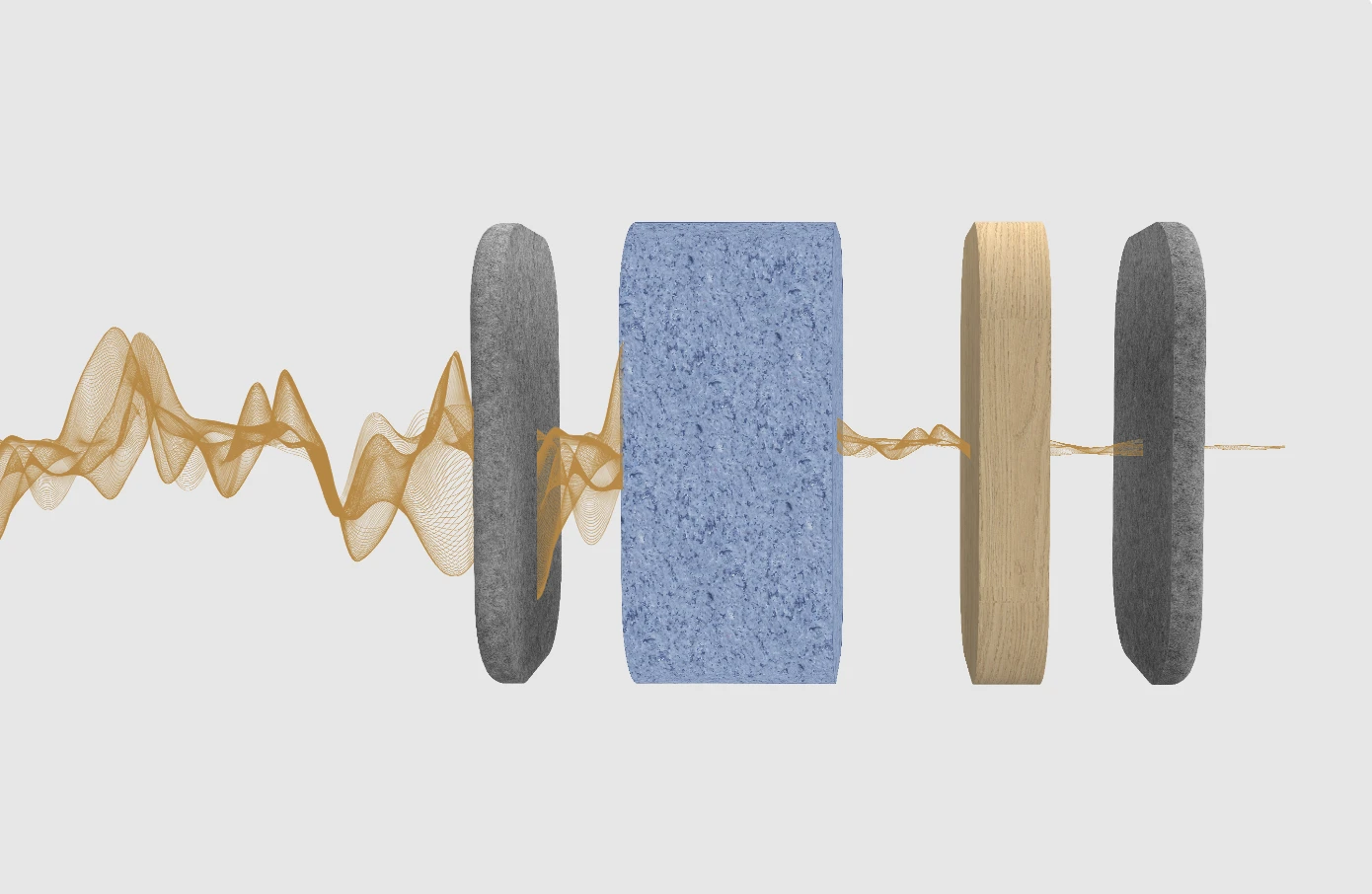
Sound insulation rests on the mass-spring-mass principle, which prevents sound waves from transmitting between two spaces. Unlike sound absorption, which treats sound quality inside a room, sound insulation aims to block noise from passing through.
Performance is measured in decibels (dB) using specific indices like DnTA (A-weighted standardised level difference) and Rw (weighted sound reduction index). According to the CSTB (France's Scientific and Technical Building Centre), a 10cm partition with rock wool can reduce airborne noise by 50 dB.
The mass-spring system works through three elements: a first dense layer, an insulating material in the middle, and a second, decoupled layer. This configuration achieves remarkable acoustic performance with no excessive thickness.
The different types of noise
Three main categories of noise disturb our everyday lives:
- Airborne noise: voices, music, TV, phone calls
- Structure-borne or impact noise: footsteps, dropped objects, moving furniture
- Equipment noise: ventilation, lifts, heating, air conditioning
Footsteps from the floor above account for 40% of complaints in shared housing, showing how important it is to treat each type of noise specifically. Every category needs its own suitable sound-insulation solutions to achieve optimal acoustic comfort.
The impact of noise on health and productivity
Consequences for health
Noise problems generate well-documented harmful effects on physical and mental health. The chronic stress caused by noise exposure leads to sleep disorders, persistent auditory fatigue, and major concentration difficulties.
The WHO finds that prolonged night-time exposure above 55 dB raises cardiovascular risk by 8%. This finding from the WHO's 2018 study on environmental noise shows the urgency of properly addressing sound insulation in our homes and workplaces.
Anxiety disorders and depression are also linked to chronic noise exposure. Quality of life gradually deteriorates, affecting social relationships and cognitive performance.
Impact in the workplace
Productivity drops by 15% in noisy open-plan offices, according to several recent studies. Difficulty concentrating comes with a significant rise in errors and high turnover in poorly sound-insulated environments.
Our customer Siemens saw a 30% improvement in employee satisfaction after installing acoustic pods. This transformation shows the direct impact quality sound insulation has on workplace wellbeing.
Stress and fatigue (-30%)
Sound insulation solutions by area
Insulating walls and partitions
Wall sound insulation relies on several proven techniques. Lining with rock wool or wood fibre offers excellent value for treating a shared wall with a neighbour. Drywall partitions with metal framing create effective, decoupled spaces.
A BA13 + 100mm rock wool + BA13 partition reaches 56 dB of reduction, based on our experience across 3,000 business customers. Treating sound bridges remains crucial for maintaining the system's overall performance.
Modern solutions also include high-density composite panels and prefabricated systems that simplify installation while guaranteeing optimal acoustic performance.
Insulating floors and ceilings
Floor sound insulation needs specific techniques to treat impact noise. Floating screeds with a resilient acoustic underlay are the go-to solution for homes and offices.
High-performance resilient underlays combine sound and thermal insulation, optimising overall comfort in treated spaces.
Solutions for openings
Laminated acoustic glazing is an essential investment for treating outside noise. A 44.2/16/44.2 glazing unit offers 42 dB of reduction, versus 28 dB for standard glazing, a 50% improvement.
Insulating doors with effective seals complete the setup. Treating roller-shutter boxes avoids sound bridges that are often overlooked but critical to overall effectiveness.
Airtightness directly affects acoustic performance: a gap covering just 1% of the surface reduces insulation by around 10 dB.
Sound insulation materials: performance and choice
Traditional fibrous insulators
Rock wool remains the benchmark, with excellent value for money. Its exceptional acoustic properties come with ease of installation and remarkable durability. Glass wool offers a thermal and acoustic versatility appreciated by professionals.
100mm rock wool reaches 58 dB of reduction for €15/m², according to our comparative lab tests meeting the ISO 23351-1:2020 standard. Cellulose wadding is an effective eco-friendly solution, particularly suited to sustainable renovation projects.
These traditional materials benefit from a long track record and rigorous certifications guaranteeing their performance over time.
Innovative bio-based materials
Wood fibre is transforming natural insulation with remarkable acoustic performance. 60mm Steico wood-fibre panels reach 52 dB of reduction while offering excellent humidity regulation.
Expanded cork combines exceptional durability with acoustic effectiveness. Its natural resistance to pests and dimensional stability make it a premium choice for demanding projects.
Recycled composite insulation panels represent the future of sustainable insulation. Our 100% French manufacturing guarantees the traceability and environmental quality of these innovative materials.
Regulations and standards for sound insulation
France's New Acoustic Regulation (NRA)
French regulations impose strict minimum thresholds for new-build housing. DnTA ≥ 58 dB between homes since 2013, under the amended Order of 30 June 1999. Renovation requirements are gradually tightening, with financial penalties for non-compliance.
Standards are moving towards stricter requirements, particularly in dense urban areas. Considering neighbourhood noise is becoming a deciding factor for planning permission.
Professionals need to keep up with these regulatory changes to offer their clients compliant, lasting solutions.
Measurement standards and certification
The ISO 23351-1:2020 standard sets out the protocols for measuring sound insulation on site. The Rw and DnTA indices allow an objective comparison of the performance of the different acoustic solutions available on the market.
Our Category B certified pods, to ISO 23351-1:2020, reach -28.3 dB measured in an independent lab. ACOTHERM and CEKAL certifications guarantee the reliability of the performance figures manufacturers advertise.
These technical benchmarks make it easier for professionals to choose and ensure the quality of the installations carried out.
Budget and implementation for sound insulation
Costs by solution
Sound insulation prices vary significantly with the technique chosen. Wall insulation ranges from €40 to €110/m², depending on the performance targeted. Acoustic partitions represent an investment of €80 to €150/m² for professional-grade performance.
A 100mm rock wool wall lining costs €65/m² installed. Turnkey solutions often offer better value than DIY for complex projects.
Return-on-investment analysis should factor in productivity and wellbeing gains, particularly significant in the workplace.
Diagnosis and implementation
A preliminary acoustic diagnosis is key to the project's success. This step precisely identifies the sources of noise and tailors solutions to the site's specific constraints.
The choice between major construction work and modular solutions depends on budget, timeline, and the flexibility you want. Installing an acoustic pod takes 1 hour with no construction work, versus 3 weeks for a traditional partition.
High-performance partition
“The feedback from our teams was clear: noise is exhausting. They need moments to recharge, to slow down and step away. The pod lets them fully isolate themselves and enjoy a zero-distraction atmosphere.”
Jérôme Bourdon
Co-founder of WiiSmile
Work With Island supports your acoustic projects
Work With Island offers professional, turnkey acoustic pods, a modern alternative to traditional insulation work. Our Island Solo, Desk, Duo, and Quattro solutions offer sound reduction of -28.7 to -31.1 dB to ISO 23351-1:2020, Category A or B depending on the model, installed in 1 hour with no construction work.
Our B Corp certification and 100% French manufacturing guarantee quality and environmental responsibility. More than 15,000+ pods installed since 2018 for prestigious customers (LVMH, Decathlon, Siemens), with a 4.9/5 satisfaction rating, reflect our recognised expertise.
Our 100-day trial, money back if not satisfied, and delivery within 6 to 8 weeks anywhere in Europe show how much we trust our solutions.
Frequently asked questions
What's the difference between sound insulation and acoustic treatment?
Sound insulation aims to stop noise transmitting between spaces, while acoustic treatment addresses sound quality inside a room. Insulation uses dense materials (the mass-spring principle); acoustic treatment favours absorption with porous materials. The two approaches are complementary for optimal comfort.
What's the best sound insulator?
Rock wool remains the benchmark, with an excellent performance-to-price ratio (58 dB for 100mm). For eco-friendly projects, Steico wood fibre offers similar performance. The choice depends on budget, thickness constraints, and the project's environmental goals.
How do you sound-insulate a shared wall?
Three main solutions: lining with metal framing and rock wool (15-20 dB gain), a decoupled counter-partition (20-25 dB gain), or a modular acoustic pod for office use (up to 31.1 dB gain). A preliminary diagnosis determines the best solution.
How much does sound insulation cost?
Prices range from €40/m² (simple lining) to €150/m² (high-performance partition). For offices, our acoustic pods start from €3,990 excl. VAT, often cheaper than a traditional partition for better effectiveness.
What thickness do you need for effective sound insulation?
A minimum of 100mm of rock wool for a 15 dB gain. For 20 dB, plan for 120-140mm. Beyond that, favour mass-spring-mass systems with two layers and a central insulator. Our pods reach -31.1 dB with just 10cm of total thickness.
Can you sound-insulate with no major construction work?
Yes, several solutions exist: removable acoustic panels, modular pods, or lightweight lining. Our Work With Island pods install in 1 hour with no drilling or connections needed, offering professional insulation that's ready to use immediately and can be relocated.
.svg)
.svg)
.svg)
.svg)







.png)